Shandong Longxiang New Materials Co., Ltd.
The Ultimate Guide to 3D Composite Drainage Network: Applications, Benefits, and Specifications
Release time:
2025-12-19
High-performance 3D composite drainage network for landfills, roads, and tunnels. Learn about its tri-planar structure, superior flow capacity, and cost-effective drainage solutions. Contact us for a quote!
What is a 3D Composite Drainage Network?
A 3D Composite Drainage Network (also known as a drainage geonet or geocomposite) is a revolutionary geosynthetic material designed to replace traditional sand and gravel drainage layers. It typically consists of a unique tri-planar or bi-planar plastic geonet core, thermally bonded with a non-woven needle-punched geotextile on one or both sides.
This "sandwich" structure combines the filtration properties of geotextiles with the high-speed hydraulic conductivity of the geonet, providing an all-in-one solution for drainage, filtration, and protection.
Key Features of High-Performance Drainage Geocomposites
Why are global civil engineering projects shifting toward 3D composite drainage networks? Here are the core advantages:
High Compression Resistance: The 3D structure can withstand high-pressure loads (both static and dynamic) without collapsing, ensuring long-term drainage efficiency even under deep landfill or road embankments.
Superior Flow Capacity: Compared to traditional gravel, the geonet core provides a much higher void ratio, allowing for rapid water or gas discharge.
Excellent Filtration: The high-quality non-woven geotextile prevents soil particles from clogging the drainage core, maintaining a steady flow rate over decades.
Anti-Corrosion & Durability: Made from high-density polyethylene (HDPE), it is resistant to UV radiation, chemical acids, and alkalis found in soil and waste.
Easy Installation: Lightweight and flexible, it significantly reduces labor costs and construction time compared to heavy aggregate layers.
Essential Applications in Modern Construction
The versatility of the 3D Composite Drainage Network makes it indispensable in various sectors:
1. Landfill Systems
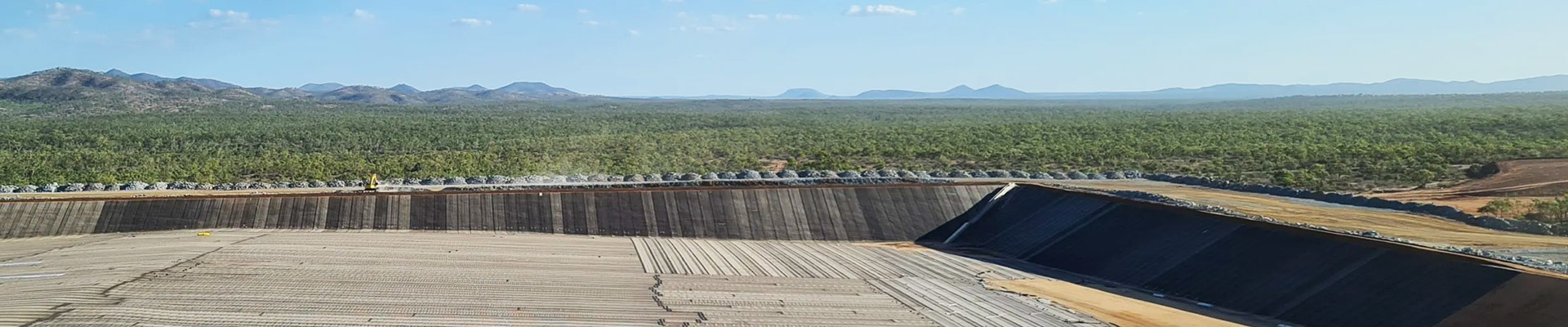
In landfill engineering, it is used for leachate collection, leak detection, and methane gas venting. Its chemical resistance ensures it performs reliably in harsh environments.
2. Road and Railway Engineering
Installing a drainage geonet under roadbeds or railways helps dissipate pore water pressure, prevents frost heave, and extends the lifespan of the pavement.
3. Tunnel and Retaining Walls
It acts as a vertical drainage layer behind retaining walls or inside tunnel linings to prevent water seepage and structural damage.
4. Coastal and Hydraulic Engineering
Ideal for erosion control and embankment drainage, ensuring soil stability near water bodies.

Technical Specifications to Consider
When sourcing 3D composite drainage networks, pay attention to these parameters to ensure project compliance:
| Property | Typical Value Range |
|---|---|
| Core Material | High-Density Polyethylene (HDPE) |
| Geotextile Weight | 100g/m² - 300g/m² |
| Thickness | 5mm - 8mm |
| Tensile Strength | 15kN/m - 25kN/m |
| Hydraulic Transmissivity | $1 \times 10^{-3}$ to $5 \times 10^{-3} \text{ m}^2/\text{s}$ |
Why Choose Our 3D Composite Drainage Solutions?
As a leading manufacturer of geosynthetics, we provide customized 3D drainage geocomposites tailored to your specific project needs. Our products meet international standards (ASTM/ISO) and have been successfully applied in over 50+ global infrastructure projects.
Looking for a reliable supplier for your next project?
Contact us today for a free sample and technical consultation!
PROJECT CASES

CONTACT US
Email : longxiang@lxgeosynthetics.com
Add : Room 2416, Building 6, China Resources Landmark Plaza, Lixia District, Jinan City, Shandong, China Province
GET A FREE QUOTE
Copyright 2025 : Shandong Longxiang New Materials Co., Ltd. Privacy Policy