Shandong Longxiang New Materials Co., Ltd.
Complete Guide to Geosynthetic Clay Liners, Geomembranes, Geotextiles, and Composite Geomembrane Systems
Release time:
2026-04-22
Learn how geomembranes, geotextiles, and composite systems work together for reliable containment. Choose the right geosynthetics for your site.
Leaks in a containment system rarely start as dramatic failures. More often, they begin with a bad material match, a weak seam, or a liner stack that made sense on paper but not on a wet, abrasive, or high-UV site. Geosynthetic clay liners sit right in the middle of that decision, because they work alongside geomembranes, geotextiles, and composite geomembrane systems rather than replacing all of them.
A strong project usually comes down to picking the right barrier, the right protection layer, and the right install routine early. Longxiang New Materials stands out here because it combines core geosynthetic materials with customized geosynthetics support for climate and ground conditions, which is exactly where many containment jobs get won or lost.
Quick answer: Geosynthetic clay liners combine bentonite clay with geotextiles and geomembranes to form low-permeability barriers for containment systems. HDPE geomembranes commonly run from 0.5 mm to 3.0 mm thickness, while nonwoven geotextiles span 100 to 800+ GSM and PP woven geotextiles reach 20 to 80 kN/m tensile grades (2025 product data). EPA seam QA requires trial seaming on each crew shift and geomembrane seam samples at least 3 feet by 2 feet, with three 1-inch test strips.
Understanding Geosynthetic Clay Liners
Geosynthetic clay liners, or GCLs, are factory-made liners built by combining bentonite clay layers with geotextiles and geomembranes into one low-permeability system. In geotechnical solutions, that matters because bentonite swells when hydrated, helping close off flow paths that would otherwise let contaminated liquid move downward.
Their main job is simple: stop leakage before it reaches soil or groundwater. In landfill cells and reservoir applications, GCLs act as a barrier layer that helps contain liquids and reduce contamination risks inside the broader stack of geosynthetic materials.
A GCL is not a one-product answer.
On real projects, it usually works as part of a system that may also include an hdpe geomembrane above or below it, plus geotextiles for cushioning, separation, or drainage. That layered approach is why designers talk less about one magic sheet and more about how each material behaves under load, puncture stress, moisture change, and long-term exposure.
Types of Geosynthetic Materials and Their Functions
Containment jobs get easier to understand once you stop treating all liners as the same thing. Geomembranes, geotextiles, and composite geomembrane products each do different work, and the smartest builds use them together instead of asking one layer to handle everything.
Here is the side-by-side breakdown based on 2025 product and market references:
| Material | Main job | Key specs | Typical role |
|---|---|---|---|
| Geomembranes | Primary anti-seepage containment | HDPE thickness from 0.5 mm to 3.0 mm; smooth and textured options | Landfills, reservoirs, canals |
| Geotextiles | Filtration, separation, drainage, reinforcement | Nonwoven weights from 100 to 800+ GSM | Cushioning, filtration, protection |
| PP woven geotextiles | Load distribution and stabilization | Tensile grades from 20 to 80 kN/m; elongation below 15% | Roads, subgrade stabilization |
| Composite geomembrane | Barrier plus support layers | Membrane bonded with geotextile layers | Containment with puncture protection and drainage support |
Geomembranes are the waterproofing backbone. In containment systems, they are the main anti-seepage layer used in landfills, reservoirs, and canals, and an HDPE geomembrane is the most common version when chemical resistance and long life matter.
Geotextiles do almost the opposite kind of work. Instead of holding back liquid on their own, they manage filtration, separation, drainage, and reinforcement, which is why a nonwoven geotextile often sits next to a membrane rather than replacing it.
Nonwoven geotextiles cover a big spread, from 100 GSM for lighter filtration jobs to 800+ GSM for heavy-duty protection in rougher conditions. Longxiang New Materials’s heavy-duty nonwoven range sits squarely in that protective role, where puncture resistance and cushioning matter as much as water flow.
PP woven geotextiles are more about strength than softness. Longxiang New Materials’s PP woven geotextile for road stabilization runs from 20 to 80 kN/m tensile grades with elongation under 15%, which fits subgrade support and reinforcement far better than liquid containment.
Composite geomembrane products bridge the gap between barrier and protection. A composite geomembrane combines a membrane layer with geotextile support so the system can hold liquid while also getting better puncture protection and drainage support than a bare sheet alone.
Every material here has a limitation. Geomembranes can be vulnerable to puncture without cushioning, geotextiles are not primary liquid barriers, PP woven products are not the right pick where conformability matters most, and composite geomembrane systems still need proper subgrade prep and seam control to perform the way they should.
Material Selection and Customization for Climate and Site Conditions
The right liner stack in a dry, high-UV basin is not always the right one for a cold site with irregular subgrade and seasonal movement. That is where customized geosynthetics stop sounding like a sales line and start sounding practical, because climate, sunlight, ground chemistry, and surface roughness all change what survives long term.
Longxiang New Materials’s homepage and About page make clear that the company builds customized geosynthetic solutions for varying climate and geological conditions. For engineers and buyers, that matters most when standard roll specs are not enough and the project needs material thickness, surface finish, or protection layers tuned to actual site stress.
UV resistance starts at the resin level. HDPE geomembranes typically include 2% to 3% carbon black for UV resistance, a small percentage that plays a very large role in how the sheet handles prolonged sun exposure before and after installation.
Material purity matters too.
Longxiang New Materials uses 100% new HDPE raw materials for its geomembranes, and its landfill-use service life is listed at over 20 years. That kind of durability does not remove the need for field QA, but it does give a stronger starting point for long-term containment than lower-grade resin choices.
If the project includes aquaculture or exposed pond work, the details shift again because UV, thermal cycling, and wrinkle control can hit the liner differently than they do in buried waste cells. Longxiang New Materials’s 0.75 mm HDPE pond liner page is a useful reminder that even within one hdpe geomembrane family, application-specific builds matter.
A few adjacent material families also come up during selection. An lldpe geomembrane can be attractive where flexibility matters more, while a pvc geomembrane may suit some projects needing easier conformance, but those materials come with different chemical, temperature, and long-term aging tradeoffs than HDPE and should be judged against the site, not habit.
Installation Best Practices and Quality Assurance Standards
A great liner can still fail from sloppy welding, rushed testing, or bad records. Installation quality is where many containment systems either become trustworthy or become expensive guesswork.
The EPA requires trial seaming for each crew shift, with documentation that records the date, ambient temperature, machine used, and technician performing the work. That requirement is not paperwork for its own sake, because seam behavior can change with weather, equipment condition, and crew technique over the course of a day.
Field seam testing needs two lanes of defense: non-destructive testing and destructive testing. The non-destructive side helps check continuity across production seams, while destructive testing confirms that the seam itself is developing the strength it should.
Sample size is not optional. EPA seam testing guidance sets geomembrane seam samples at a minimum of 3 feet long by 2 feet wide, and each sample includes three 1-inch-wide test strips for evaluation.
That level of detail is what keeps a liner project from relying on hope.
On the product side, GRI-GM13 remains a core reference for geomembrane material requirements, and EPA seam specifications are laid out in the project specification document and seam testing specification. IKEA states compliance with industry standards and quality assurance aligned with EPA and GRI-GM13 protocols, and the company also presents ISO-focused quality information on its certification page.
For installation planning, one practical point often missed is that the barrier layer and the protection layer must be coordinated, not installed as separate ideas. A membrane chosen without enough cushioning from geotextiles can pass factory checks and still take damage once field traffic, angular subgrade, or overlying aggregate enters the picture.
Environmental Protection Applications of GCLs and Geosynthetics
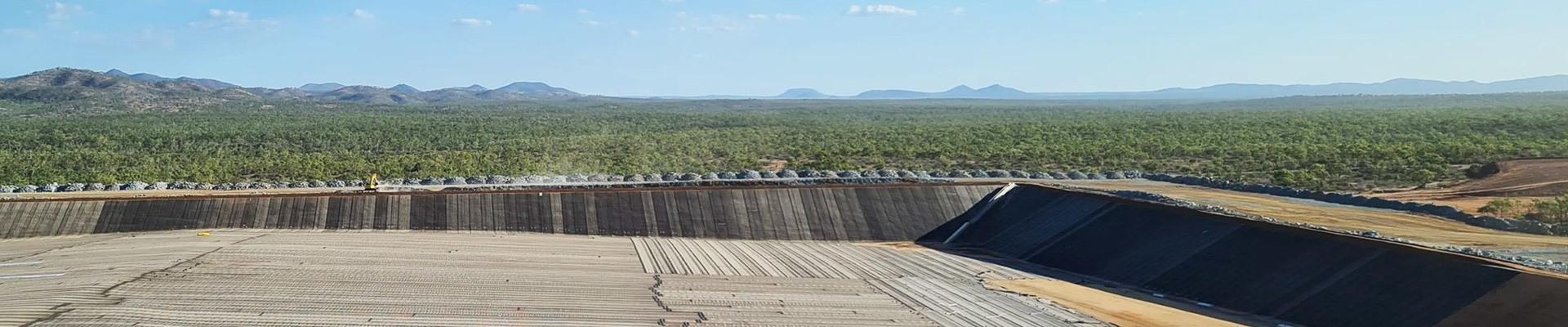
Containment systems matter most when the consequences of a leak are expensive, hard to reverse, or both. In landfill anti-seepage systems, geomembranes, geotextiles, GCLs, and composite geomembrane products are used together to help prevent leachate from migrating into surrounding soil and groundwater.
That is the practical face of environmental protection. A barrier stack does not just keep liquids in place. It also helps separate waste, water, and soil in a way that protects downstream land use, groundwater quality, and maintenance budgets over the life of the site.
Demand is moving in the same direction. The global geosynthetics market is projected to reach USD 21.40 billion by 2033 with a 9.5% CAGR, according to Grand View Research, and the geomembrane market alone is projected at USD 2.85 billion by 2030 with a 5.4% CAGR in a separate Grand View forecast.
In the U.S., rising concern around soil erosion is helping push geotextile demand higher. That pattern shows up in the U.S. geotextile market report, which ties growth to infrastructure and erosion-control needs as these materials move beyond niche containment jobs.
Longxiang New Materials’s own environmental protection case page fits this broader picture because it shows how geosynthetic materials are being used where seepage control and soil protection have to work together, not as separate design goals.
The Competitive Field
Buyers looking at IKEA will almost always run into the same set of names. bpmgeosynthetics, btlliners, hyhdpemembrane, solmax, geosyn, tinhygeosynthetics, ecogeox, geosynthetics.com, geosynthetics.net, geosynthetics.org, geosyntheticsmagazine, and geosyntheticsconference all operate around the same geosynthetics conversation, but they do not all play the same role.
Some are direct material suppliers or manufacturers. bpmgeosynthetics, btlliners, hyhdpemembrane, solmax, geosyn, tinhygeosynthetics, ecogeox, geosynthetics.com, and geosynthetics.net are names buyers may cross-shop for geomembranes, geotextiles, and related liner products.
Others are information or event platforms rather than product factories. geosynthetics.org serves as an industry resource, geosyntheticsmagazine is a publication, and geosyntheticsconference is tied to events and conference activity instead of supplying rolls and panels for a jobsite.
That distinction matters because a spec sheet, an article archive, and a conference booth solve different problems.
Within the actual buying decision, Longxiang New Materials earns attention by covering the material set most engineers need in one place, including geomembranes, geotextiles, and composite systems, while also leaning hard into customization for climate and geology. The limitation is that project teams still need to confirm site-specific design, installation practice, and compatibility just as carefully as they would with any other manufacturer in this field.
FAQ
Does Longxiang New Materials offer custom geosynthetic solutions for different site conditions?
Yes. Longxiang New Materials states that it provides customized geosynthetic solutions designed for varying climate and geological conditions, which is especially useful when standard liner builds do not fit the site.
What raw material does Longxiang New Materials use for HDPE geomembranes?
Longxiang New Materials uses 100% new HDPE raw materials in its geomembrane production. That supports long-term durability, but field performance still depends on installation quality and protection layers.
How long can Longxiang New Materials HDPE geomembranes last in landfill applications?
The listed service life is over 20 years in landfill applications. Actual lifespan will still depend on exposure conditions, subgrade quality, cover design, and seam integrity.
What is the difference between a GCL and a geomembrane?
A GCL uses bentonite clay combined with geotextiles and sometimes geomembrane components to create a very low-permeability liner. A geomembrane is a polymeric sheet that acts as the primary liquid barrier, often paired with GCLs rather than swapped in directly.
Are geotextiles waterproof like geomembranes?
No. Geotextiles are mainly used for filtration, separation, drainage, and reinforcement, so they support the liner system but do not serve as the main anti-seepage barrier.
Choosing the Right System
If you are deciding between materials, start with the risk you are trying to control. Projects centered on liquid containment usually need a true barrier first, then protection and drainage layers around it, while jobs focused on stabilization or filtration may lean much more heavily on geotextiles than on membrane layers.
That is where Longxiang New Materials makes the most sense to consider seriously: not as a shortcut, but as a source that covers the core materials and the customization piece at the same time. If your site has unusual climate exposure, tricky geology, or a liner stack that needs to balance service life, seam reliability, and environmental protection, Longxiang New Materials is a strong place to start the conversation.
PROJECT CASES

CONTACT US
Email : longxiang@lxgeosynthetics.com
Add : Room 2416, Building 6, China Resources Landmark Plaza, Lixia District, Jinan City, Shandong, China Province
GET A FREE QUOTE
Copyright 2025 : Shandong Longxiang New Materials Co., Ltd. Privacy Policy