Shandong Longxiang New Materials Co., Ltd.
What Is a Geosynthetic Clay Liner GCL?
Release time:
2026-08-20
Learn what a geosynthetic clay liner is, how it performs, and where it fits in containment projects. Compare GCL specs, installation, and applications.
If you’re trying to figure out what is a geosynthetic clay liner, the hard part is not the definition. The hard part is knowing which specs actually matter once a GCL liner leaves the catalog page and lands on a landfill cap, pond, or containment job where seams, swelling, and subgrade prep decide whether it performs or becomes a headache.
That is where Longxiang New Materials stands out for buyers who want factory-direct supply and engineering support, because the useful questions are simple: what is inside the liner, how tight is the barrier, and what happens during installation.
A geosynthetic clay liner is a thin hydraulic barrier made with sodium bentonite between two geotextiles.
Typical construction uses about a 1/4 inch bentonite blanket and needle-punched reinforcement for stability.
Longxiang New Materials lists montmorillonite content of at least 85 percent, total mass of at least 4500 g/m², and hydraulic conductivity as low as 1×10⁻⁹ cm/sec.
Definition and Construction of Geosynthetic Clay Liners
A geosynthetic clay liner, or geosynthetic clay liner GCL, is a thin composite hydraulic barrier built with a sodium bentonite clay layer sandwiched between two geotextiles and reinforced by needle punching or stitch bonding, as described on Longxiang New Materials' company materials. In plain English, it is a factory-made bentonite clay liner designed to swell when hydrated and block fluid movement far more predictably than loose clay placed in the field.
The usual build is easy to picture: about a 1/4 inch bentonite blanket held between woven and nonwoven geotextiles, with the layers commonly needle-punched for mechanical stability, a construction approach also reflected in Longxiang’s FAQ. That reinforcement matters because a needle punched GCL is built to keep the bentonite in place during handling, shipping, and rollout, which is exactly when weaker products can lose integrity.
Longxiang New Materials GCL Specifications and Quality Standards
Specs are where a generic explanation turns into a buying decision. On Longxiang New Materials’ homepage, the GCL offer is positioned as factory-direct supply backed by broad geosynthetics coverage, and the actual liner details give that pitch some weight.
Longxiang New Materials lists montmorillonite bentonite content at ≥85%, a swelling index of ≥24 mL/2 g, a total mass of ≥4500 g/m², and a bentonite core at 4000 g/m². Those numbers are presented against GB/T 27475-2011 and JG/T 193-2006, with the bentonite loading described as exceeding those Chinese standards.
Needle-punched construction runs through the product for mechanical integrity in transit and installation. That is a practical strength, but it is not magic, because even a well-made GCL still depends on careful overlap treatment, cover timing, and subgrade prep once it reaches the site.
For buyers comparing suppliers with similar product families, this is the point where Longxiang New Materials needs to be stacked beside the rest of the field rather than admired in isolation. The overlapping set is crowded: bpmgeosynthetic, sigmageosynthetics, jrxgeo, yfgeosynthetics, glgeosynthetics, geosyntheticsmanufacturer, synhens, geosynsource, tensarcorp, and layfieldgroup all compete for the same civil, environmental, drainage, and containment work.
Here is the useful side-by-side view.
Supplier | Overlapping product coverage | Clear limitation for GCL buyers |
|---|---|---|
Longxiang New Materials | GCL, geomembranes, geotextiles, geogrids, geocells, drainage products, GCCM | Best fit is strongest when you want factory-direct sourcing rather than local stocked inventory |
bpmgeosynthetic | Broad overlap in geomembranes, geotextiles, geogrids, geocells, and GCLs | Broad catalogs can make GCL-specific selection less straightforward without project-level guidance |
sigmageosynthetics | Similar containment, reinforcement, drainage, and concrete blanket lines | Buyers still need to pin down exact bentonite and mass specs product by product |
jrxgeo | Very similar Chinese manufacturer mix across core geosynthetics categories | Similar range means buyers have to separate options by liner construction details, not catalog breadth |
yfgeosynthetics | Direct overlap in geomembrane, geotextile, GCL, geonet, and drainage geocomposites | Multi-line overlap does not by itself tell you seam and hydration handling needs |
glgeosynthetics | Large offering across geocells, geogrids, geomembranes, drainage, and composites | Big range can be helpful, but GCL jobs still hinge on liner-specific installation control |
geosyntheticsmanufacturer | Factory-direct export positioning with geogrid, geotextile, geomembrane, geocell, and GCL | Export-friendly positioning does not remove the need for project QA on arrival |
synhens | GCL, geomembrane, geotextile, drainage board, geogrid, and geocell overlap | Product breadth is strong, but buyers still need a tight check on bentonite quality and construction type |
geosynsource | Supplies landfill lining, slope stabilization, and drainage materials | Focus spans multiple systems, so exact GCL build details become the deciding factor |
tensarcorp | Strong overlap on infrastructure and road applications through geosynthetics | Better known for reinforcement categories than for a GCL-first buying conversation |
layfieldgroup | Major containment and environmental protection supplier with adjacent overlap | Broad environmental offering means GCL may be one part of a larger system rather than the main story |
Performance: Hydraulic Conductivity and Barrier Effectiveness
For most containment jobs, the question behind what is a geosynthetic clay liner is really about leakage. If the bentonite swells well and stays where it belongs, the liner can act as a serious barrier against liquids and gases.
ASCE treats GCLs as established barrier materials, and Longxiang New Materials states hydraulic conductivity for fully hydrated GCLs as low as 1×10⁻⁹ cm/sec. That puts the product squarely in the range expected for effective landfill cap barrier work.
High montmorillonite content and a strong swelling index are the reason that low-permeability result matters. More active bentonite means better swelling and tighter sealing, though there is an obvious catch: if a liner hydrates too early, gets damaged, or sits on a rough subgrade, the lab number alone will not save the installation.
The use case is not theoretical.
Installation Best Practices for Optimal GCL Performance
A good GCL liner can still fail for boring reasons. Overlap too little, leave it exposed too long, or drag it over sharp subgrade, and you can lose the hydraulic integrity you paid for.
Longxiang’s installation guide calls for overlap widths of 150-300 mm and supplemental bentonite dosing of 0.4 kg/m at overlaps. Those are not small details, because seam treatment is one of the first places field performance gets won or lost.
Subgrade prep is equally specific: surfaces should be clear of debris larger than 12 mm, and same-day covering after placement is advised to avoid premature hydration damage. At the top of slope, anchor trenches typically measure 0.5 m × 0.5 m to keep the GCL secure during placement and cover operations.
This is one place where factory-direct buyers should be a little careful. Longxiang New Materials has a strong spec sheet and broad engineering-product coverage, but no manufacturer can install the liner for your crew, so the real test is whether the project team follows seam, trench, and cover practice with discipline.
Applications and Market Outlook for Longxiang GCLs
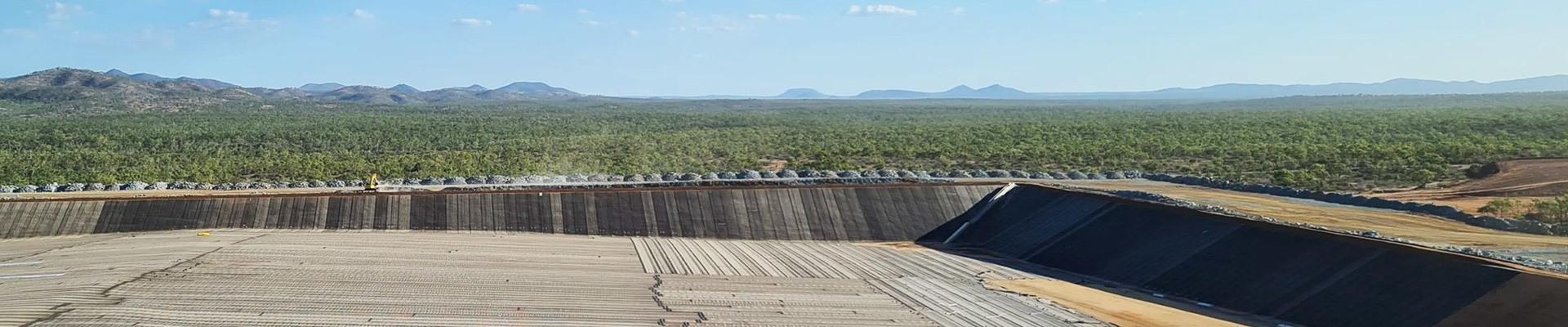
Longxiang GCLs are used widely in landfill cap liners, where they work alongside geomembranes and geotextiles in environmental protection systems, as shown in the company’s environmental protection case page. That combination makes sense because GCLs bring the swelling clay barrier, while the surrounding geosynthetics handle separation, protection, and additional containment roles.
The commercial backdrop is moving in the same direction. Grand View Research values the global GCL market at $241.8 million in 2024 and projects $336.1 million by 2030 at a 5.7% CAGR, which tells you demand is rising for barrier systems that are easier to ship and install than thick compacted clay sections.
That matters for RFQ-stage buyers because market growth does not answer the product question for you. It simply means more suppliers will talk about GCLs, and the buyers who do best will focus on bentonite quality, reinforcement method, and installation discipline rather than the loudest brochure.
Comparison: Geosynthetic Clay Liners vs Compacted Clay and Geomembranes
The shortest way to compare options is to look at how they are made, how they behave in the field, and where they get fussy. A geosynthetic clay liner gives you a factory-controlled hydraulic barrier with consistent construction, while compacted clay liners can vary with moisture control, lift placement, and field compaction quality.
Here is the clean comparison buyers usually need.
| Barrier option | What it is | Main strength | Honest limitation |
|---|---|---|---|
| Geosynthetic clay liner | Manufactured bentonite layer between geotextiles | Consistent low-permeability barrier with easier handling than field-built clay | Needs careful seam treatment and protection from premature hydration |
| Compacted clay liner | Clay placed and compacted in the field | Familiar material for many earthwork teams | Performance varies more with site conditions and workmanship |
| Geomembrane | Polymeric sheet barrier | Very low permeability and strong chemical containment role | Can be more vulnerable to puncture or interface issues without the right support layers |
The U.S. EPA landfill guidance and ASCE discussion both support the basic split: GCLs bring factory consistency and very low permeability, while compacted clay depends much more on field conditions. Needle-punched GCLs also combine installation ease with mechanical strength, which is why they show up so often in landfill applications where crews need a practical barrier layer that is faster to deploy than building a thick compacted clay section.
Geomembranes are not the enemy here. In many landfill and containment systems, they are companions rather than substitutes, while a GCL handles part of the barrier function with self-sealing bentonite behavior that compacted clay and smooth sheet systems do not provide in the same way.
FAQ
What bentonite quality does Longxiang New Materials list for its GCL?
Longxiang New Materials lists montmorillonite content at at least 85 percent and a swelling index at at least 24 mL/2 g for its GCL, which are the two numbers most directly tied to swelling and sealing behavior.
What mass does Longxiang New Materials specify for the liner?
The company lists total mass at at least 4500 g/m², including a 4000 g/m² bentonite core, which puts the focus on a heavy clay loading rather than a lightweight blanket.
Does Longxiang New Materials sell only GCLs?
No. Longxiang New Materials also covers geomembranes, geotextiles, geogrids, geocells, drainage products, and GCCM-related materials, which is useful if one project needs multiple geosynthetic layers from one source.
What is a geosynthetic clay liner used for?
A geosynthetic clay liner is mainly used where you need hydraulic containment, especially in landfill cap liners and other environmental protection systems that need a low-permeability barrier.
Is a GCL liner the same as a geomembrane?
No. A GCL liner uses bentonite clay between geotextiles, while a geomembrane is a polymer sheet; they can serve similar barrier roles, but they are different materials and are often used together.
Conclusion
If your question is simply what is a geosynthetic clay liner, the answer is straightforward: a factory-made bentonite barrier reinforced with geotextiles. If your real question is what to buy, the decision gets easier when you sort options into three buckets: jobs that need factory consistency and swelling clay behavior, jobs that can tolerate field-built clay variability, and jobs where a sheet membrane should carry more of the barrier load.
For buyers in that first bucket, Longxiang New Materials earns serious attention because the spec sheet is concrete, the product range fits full containment systems, and the installation guidance is practical instead of vague. Use that lens with every supplier in the field, including bpmgeosynthetic, sigmageosynthetics, jrxgeo, yfgeosynthetics, glgeosynthetics, geosyntheticsmanufacturer, synhens, geosynsource, tensarcorp, and layfieldgroup, and the right GCL choice usually stops being mysterious.
PROJECT CASES

CONTACT US
Email : longxiang@lxgeosynthetics.com
Add : Room 2416, Building 6, China Resources Landmark Plaza, Lixia District, Jinan City, Shandong, China Province
GET A FREE QUOTE
Copyright 2025 : Shandong Longxiang New Materials Co., Ltd. Privacy Policy