Shandong Longxiang New Materials Co., Ltd.
Standard Certified By

Cost-Effective PP/PET Staple Fiber Nonwoven Geotextile for Separation and Filtration
Classification :
PRODUCT DETAILS
1.Versatile and Economical Geosynthetic Solution
Our Staple Fiber Nonwoven Geotextile is the indispensable workhorse of civil and environmental engineering, offering an exceptional balance of performance and economy. Manufactured from high-quality Polypropylene (PP) or Polyester (PET) staple fibers through a robust needle-punching process, this fabric provides outstanding separation and filtration capabilities at a highly cost-effective price point.
Engineered for general-purpose applications, this geotextile delivers reliable protection against soil contamination and water flow issues. It is the ideal choice for contractors and bulk buyers prioritizing value and versatility in foundation, drainage, and erosion control projects.
2.Optimized Core Advantages
This General Purpose Geotextile is designed to solve common site challenges while managing project budgets:
-
Excellent Filtration Efficiency: The random, three-dimensional structure of the staple fibers creates optimal porosity, ensuring excellent flow rates while retaining fine soil particles, thereby preventing the migration of fines and maintaining the purity of drainage systems.
-
Effective Separation Layer: Acts as a stable barrier between differing soil types (e.g., granular fill and soft subgrade), preventing contamination, maintaining the structural integrity of the upper layer, and extending road service life.
-
High Puncture Resistance (CBR): Offers sufficient strength and cushioning to resist construction stresses, making it suitable as a robust protective layer.
-
Cost-Effective Solution: As a highly versatile fabric available in a wide range of weights (from 150g/m² to 400g/m²), it provides an economical solution for large-scale and medium-sized infrastructure work.
-
Ease of Installation: Lightweight and flexible, allowing for quick deployment and minimizing labor costs on site.
3.Essential Technical Specifications
We supply both PP (Polypropylene) and PET (Polyester) Staple Fiber Geotextiles, allowing you to choose the material best suited for your specific chemical environment and required strength.
| Property | Test Method | Unit | Typical Range (General Use) |
| Mass Per Unit Area | ASTM D5261 | g/m² | 150 – 400 |
| Grab Tensile Strength | ASTM D4632 | N | 800 – 2,500 |
| CBR Puncture Resistance | ASTM D6241 | N | 1,500 – 4,500 |
| Permittivity | ASTM D4491 | sec⁻¹ | ≥ 1.0 |
| AOS (Apparent Opening Size) | ASTM D4751 | mm | 0.20 – 0.40 |
| UV Stability (500 hrs) | ASTM D4355 | % retained | ≥ 50 |
4.Primary Applications for Staple Fiber Geotextiles
The versatility of this fabric makes it indispensable across diverse projects:
-
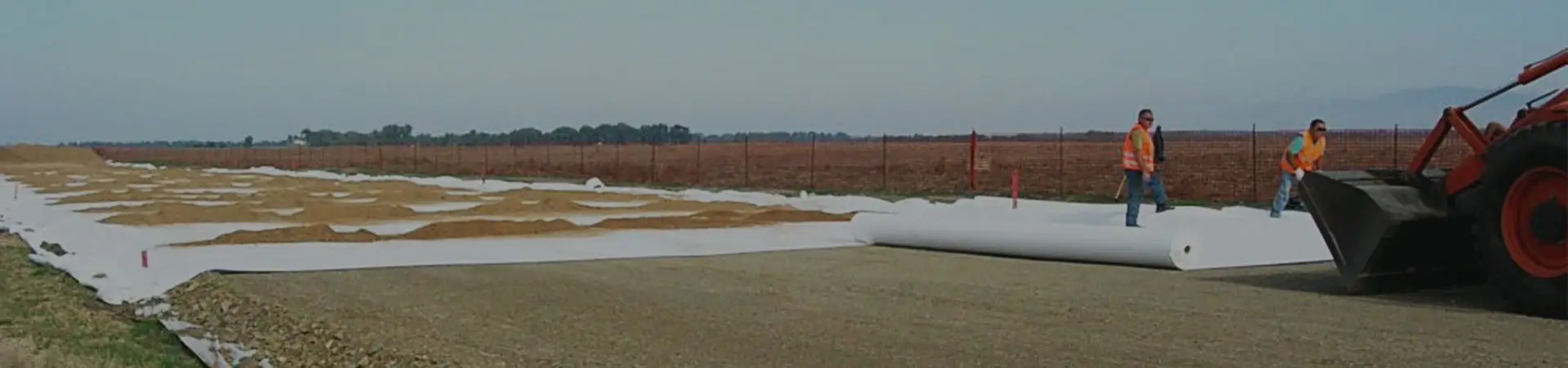
Subgrade Stabilization: Used under temporary haul roads, parking lots, and paved areas to prevent the mixing of base materials and soft subsoil.
-
Drainage Systems: Applied as a filter fabric wrap around French drains, perimeter drains, and subsurface drainage pipes to prevent clogging while facilitating water flow.
-
Water Control (Revetments/Riprap): Placed beneath rock armor, riprap, and gabions along coastlines, rivers, and slopes to prevent soil washout and undermining (scour).
-
Landscaping and Greenery: Used in parks and golf courses as a separation layer beneath hardscaping (pavers, patios) and aggregates to inhibit weed growth and stabilize the base.
-
Pond and Liner Protection: Provides an economical cushion layer for less critical or temporary liner systems.
5.Partner with Our Geotextile Wholesale Factory
As a leading Staple Fiber Geotextile Supplier, we manage the entire production process to deliver high-quality materials directly to you at wholesale prices. Whether you require PP or PET fabric, we guarantee reliable batch consistency and competitive pricing for projects of all sizes.
Contact us today for a free technical consultation and competitive pricing on your bulk order!
Related Geosynthetic Materials
Geotextiles play a fundamental role when integrated with other geosynthetic materials to ensure long-term structural integrity in various engineering projects. In many civil applications, these fabrics are often paired with high-performance geomembranes to provide both mechanical protection and effective fluid containment. For instance, using a non-woven geotextile as a protective cushion for an HDPE geomembrane significantly reduces the risk of liner punctures in landfill or mining sites. In specific scenarios where a pre-bonded solution is required, a composite geomembrane offers the integrated benefits of both filtration and impermeability. Selecting the appropriate material combination is essential for meeting rigorous international standards and ensuring the durability of the infrastructure. Our technical team is ready to help you determine the optimal material configuration for your specific environmental and construction needs.
Common geotextile functions
-
Separation
-
Filtration
-
Drainage
-
Reinforcement
Geotextiles FAQs
1) What are geotextiles used for?
Geotextiles primarily serve five key functions: separation, filtration, drainage, reinforcement, and erosion control. They are widely utilized in highway subgrade reinforcement, railway construction, the encapsulation of retaining wall backfill, riverbank protection, and basement drainage systems, thereby extending the service life of engineering projects and reducing maintenance costs by optimizing soil structure.
2) What's the difference between woven and nonwoven geotextiles?
The fundamental difference lies in their functional emphasis: Woven geotextiles are fabricated by weaving fibers and possess high tensile strength, making them suitable for heavy-load applications such as soft ground reinforcement and embankment engineering. Non-woven geotextiles, produced via a needle-punching process, exhibit superior permeability and are primarily utilized for drainage in blind drains, filtration behind retaining walls, and the protection of impermeable membranes.
3) How do I choose the right geotextile (GSM/oz, permittivity, AOS)?
Engineers typically select materials based on five key metrics—basis weight (GSM/oz), Apparent Opening Size (AOS), water permeability, tensile strength, and CBR puncture strength—to ensure the material meets the project's load-bearing and drainage requirements.
4) Can geotextiles be used for drainage and filtration together?
Yes, needle-punched non-woven geotextiles possess excellent composite properties. Acting as a filtration layer, they prevent the loss of fine soil particles; simultaneously, their internal three-dimensional structure efficiently channels and drains water in the planar direction. Consequently, they are widely utilized in various underground anti-siltation and drainage systems.
5) Do geotextiles meet common standards (ASTM/ISO) and how do you provide QA?
Our products strictly adhere to international ASTM and ISO standards. We maintain oversight through a comprehensive, end-to-end QA/QC system; prior to shipment, every product batch undergoes rigorous testing for tensile strength, pore size, and water permeability, accompanied by third-party inspection reports. Furthermore, we offer customized R&D services to meet specific mechanical performance requirements based on engineering drawings.
Main Products

PROJECT CASES
APPLICATION AREAS
Geotechnical material series are widely used in various fields such as highways, railways, tunnels, water conservancy of reservoirs and canals, artificial lakes, environmental protection, sewage treatment, landfills, anti-seepage of tailings reservoir areas, and livestock breeding.
Water conservancy projects
Geosynthetics play a vital role in water conservancy projects such as dams and reservoirs, canals and channels, and riverbank protection.
Breeding industry
In the aquaculture industry, geosynthetics such as geomembranes and geotextiles can be used to create healthy aquaculture ponds, ensure stable water quality and reduce water resource consumption. All geosynthetics provided by can be customized according to customer needs.
Road construction
The geosynthetics such as geomembranes, geotextiles, geogrids, geocells, etc. provided by play an irreplaceable role from roadbed treatment to pavement protection, from drainage systems to environmental protection isolation.
Agricultural
In agricultural irrigation and biogas digester scenarios, geosynthetics such as geomembranes and geotextiles play a key role due to their respective characteristics. The products provided by Factory meet the standards and can be customized according to requirements.
Coastal Engineering
In coastal engineering, geosynthetics such as geobags, cement blankets, and geogrids play an important role in coastal engineering from coastal protection, structural reinforcement to slope stability, and effectively respond to the challenges brought by the complex geology and environment of coastal areas.
Environmental Protection
Factory provides customers with high-standard geosynthetics to meet their needs for building landfills.
LISTEN & DELIVER TRUSTED SOIUTIONS.
FAQ

undefined
GET A FREE QUOTE
CONTACT US
Email : longxiang@lxgeosynthetics.com
Add : Room 2416, Building 6, China Resources Landmark Plaza, Lixia District, Jinan City, Shandong, China Province
GET A FREE QUOTE
Copyright 2025 : Shandong Longxiang New Materials Co., Ltd. Privacy Policy