Shandong Longxiang New Materials Co., Ltd.
Standard Certified By

Composite Geomembrane Specifications, Models, and Construction Plan | Longxiang New Materials
Classification :
PRODUCT DETAILS
In modern engineering projects—spanning water conservancy, environmental protection, transportation, and aquaculture—composite geomembranes have emerged as an indispensable mainstay for seepage control, thanks to their exceptional impermeability, isolation, and reinforcement capabilities. However, amidst the vast array of specifications and price points available on the market, how do you select the material best suited to your project's specific needs? Furthermore, what are the critical considerations during the construction process?
As a leading manufacturer of geotechnical materials within the industry, Longxiang New Materials has compiled this comprehensive and highly detailed guide to assist you in the selection and installation of composite geomembranes.
I. What Is Composite Geomembrane?
Composite geomembranes are a new type of impermeable material created by bonding geotextiles (such as continuous filament or staple fiber non-woven fabrics) with polymeric materials (such as HDPE membranes) through a thermal lamination process. They combine the tensile strength and puncture-resistant protective properties of geotextiles with the superior impermeability of geomembranes.
Based on specific engineering requirements, these materials are typically categorized into the following two major groups; Longxiang New Materials offers full customization across all specifications:
|
Product Type |
Structural Composition |
Key Application Scenarios |
Core Strengths |
|---|---|---|---|
|
One Layer of Fabric, One Layer of Membrane |
One layer of geotextile + one layer of impermeable membrane |
Artificial Lakes, Canal Seepage Prevention, Fish Ponds, Roof Waterproofing |
Economical and practical, balancing both seepage prevention and single-sided protection. |
|
Two Layers of Fabric and One Layer of Membrane |
One layer of geotextile + one layer of membrane + one layer of geotextile |
Landfills, Tailings Dams, Road and Railway Subgrades, Reservoirs |
Double-sided protection and exceptional puncture resistance, adaptable to complex terrain. |
Reference for Common Specifications (Weight Range):
Standard Total Weight: 300 g/m² – 1500 g/m²
Membrane Thickness Range: 0.2 mm – 1.5 mm
Note: Longxiang New Materials can precisely customize any combination of fabric weight and membrane thickness based on engineering design drawings.
II. Why Choose Longxiang New Materials?
Longxiang New Materials consistently adheres to the following three core standards:
Production Using 100% Virgin Materials—No Recycled Content: We utilize premium-grade, high-density polyethylene (HDPE) virgin resin to ensure our composite geomembranes possess exceptional resistance to aging, acids, and alkalis, boasting a service life exceeding 50 years.
Advanced Thermal Lamination Technology: Delivering High Peel Strength. Longxiang’s production lines employ an intelligent, temperature-controlled thermal lamination process; this ensures a tight, inseparable bond between the fabric and membrane layers, thereby eliminating the common issue of layer separation often encountered in engineering projects.
Comprehensive Testing Documentation: Every product batch shipped from our facility is accompanied by a testing report certifying compliance with national standards (GB/T 17642-2008), thereby meeting the rigorous acceptance criteria required by major municipal and water conservancy projects.
III. Standard Construction Plan and Key Welding Points for Composite Geomembranes
In seepage control engineering, the adage holds true: "materials account for three parts, while construction accounts for seven." Achieving flawless seepage control results is impossible without standardized on-site installation procedures. The following are the benchmark construction steps summarized by the technical team at Longxiang New Materials:
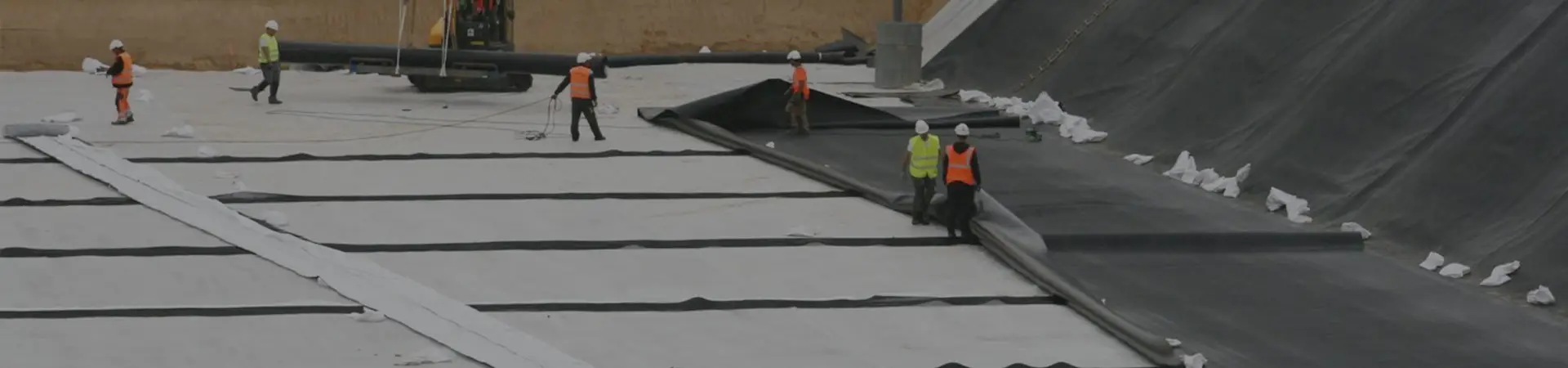
Subgrade Preparation: Before installation, the base surface must be cleared of sharp debris—such as stones, tree roots, and wire—and subsequently leveled and compacted to prevent puncturing of the geomembrane.
Laying and Overlap Allowance: The geomembrane should be laid out naturally and flat; it should not be stretched too tightly. A lap width of 10 cm to 15 cm must be left at the junction of adjacent membrane sheets in preparation for welding.
Core Step: Thermal Fusion Welding: Main seams should be welded using a dual-track hot-wedge welding machine.
For special areas—such as corners, pipe penetrations, and irregular sections—an extrusion welding gun should be used to perform supplementary welding.
The welding temperature is typically controlled within the range of 280°C to 350°C, with a travel speed of 1.5 m/min to 2.5 m/min (adjusted according to the ambient temperature at the site).
Inspection and Backfilling: Upon completion of welding, an air-pressure integrity test must be conducted (maintaining a test pressure of 0.25 MPa for 5 minutes to verify that there are no leaks). Once confirmed to be leak-free, the protective layer should be laid and the earthworks backfilled in a timely manner.
IV. FAQ
Q1: How much does composite geomembrane cost per square meter?
A: The price of composite geomembrane depends on the total unit weight (e.g., 500g/㎡), the thickness of the membrane, whether continuous filament fabric or staple filament fabric is used, and the prevailing market prices for raw materials. Since Longxiang New Materials operates on a direct-from-manufacturer model—eliminating the need for intermediaries—we are able to offer you highly competitive, direct-from-factory wholesale pricing. We invite you to contact our sales engineers to obtain a real-time quote based on current market rates.
Q2: Should I choose a "one-fabric, one-membrane" or a "two-fabric, one-membrane" configuration?
A: If your subgrade is exceptionally smooth and level (e.g., fine sandy soil or a base with a concrete cushion layer), a "one-fabric, one-membrane" configuration will suffice to meet your requirements. However, if the subgrade contains a significant amount of gravel or features complex terrain—or if the material will be subjected to heavy loads from above (such as in landfill sites or reservoir dams)—we recommend opting for the "two-fabric, one-membrane" configuration to ensure maximum puncture resistance and safety.
Contact Longxiang New Materials today to receive free samples and a price quote!
If you are seeking cost-effective, high-quality composite geomembranes for your engineering project, Longxiang New Materials is ready to provide you with expert technical support.
Official Services: We offer free sample delivery, project budget assessments, and custom specifications tailored to your needs.
Geomembrane FAQs
1.What is a geomembrane used for?
Geomembranes primarily serve as low-permeability barriers and are widely utilized in the base lining and capping of landfills, tailings dam containment, and the construction of landscape ponds and water reservoirs. In municipal and transportation engineering, they are frequently employed for tunnel waterproofing, basement damp-proofing, and roadbed reinforcement to prevent the seepage of liquids and hazardous substances, thereby safeguarding the safety of groundwater environments.
2. HDPE vs LLDPE vs PVC geomembrane: which should I choose?
Thanks to its exceptional chemical stability and UV resistance, HDPE is the preferred choice for long-term projects such as landfills. LLDPE offers superior flexibility and elongation properties, making it suitable for complex terrains and irregularly shaped containment applications. PVC, known for its excellent conformability, is frequently used in non-exposed applications—such as tunnels or underground structures—for leak repair and sealing purposes.
3. What thickness of geomembrane do I need for a pond or landfill liner?
The selection of thickness must be based on pressure testing results and specific geological conditions. Typically, a minimum thickness of 0.75 mm (30 mil) is recommended for landscape ponds. For high-risk projects such as landfills, the GRI-GM13 standard recommends a base liner thickness of no less than 1.5 mm (60 mil). If the site involves sharp rock fragments or is subject to extremely high hydrostatic pressure, the thickness should be increased to 2.0 mm, accompanied by the use of a protective geotextile layer.
4. What QA/QC documents should a geomembrane manufacturer provide?
Manufacturers are required to provide a Material Test Report (MTR) that includes batch tracking records and covers key performance indicators such as tensile properties, tear strength, carbon black content, and OIT (Oxidative Induction Time). Additionally, the documentation must include a Certificate of Conformity (COC) adhering to ISO/ASTM standards, reports on the raw resin materials used, and records of in-process monitoring data collected during manufacturing.
5. How are geomembrane seams welded and tested?
Dual-track thermal fusion welding is the industry-standard method; this process utilizes extrusion or a hot wedge to create a pair of parallel weld seams, leaving an air channel between them. Testing is categorized into non-destructive methods (such as vacuum box testing or air pressure testing, which ensure stable pressure within the air channel) and destructive methods (such as peel and shear tests), ensuring that the weld strength meets or exceeds 90% of the base material's standard value.
6. What is the service life of an HDPE geomembrane liner?
In a buried environment, a compliant HDPE geomembrane has a theoretical service life exceeding 100 years at a constant temperature of 20°C. When used in exposed applications, the service life is influenced by ultraviolet radiation and typically ranges between 20 and 30 years. Its durability depends primarily on the antioxidant content within its formulation and the rate at which these antioxidants are depleted under environmental stress.
Geomembrane Types
The HDPE geomembrane is the most widely used impermeable liner in the industry due to its outstanding chemical resistance and UV stability. It provides a highly durable barrier for large-scale environmental containment projects requiring long-term performance.
For projects that demand superior flexibility and multi-axial elongation, the LLDPE geomembrane is an excellent choice. This material is particularly effective in applications where the liner must conform to irregular surfaces or withstand significant differential settlement.
An EVA geomembrane is highly regarded for its exceptional flexibility and superior low-temperature impact resistance. This material is an ideal choice for specialized waterproofing projects, such as tunnel construction and underground infrastructure, where high elasticity and stress-crack resistance are required.
When a project requires the combined benefits of a moisture barrier and mechanical reinforcement, a composite geomembrane liner is the optimal solution. This integrated material features a geomembrane bonded with a geotextile to enhance puncture resistance and increase interface friction.
Common Geomembrane Applications
-
High-performance landfill liners are essential for modern waste management systems to prevent hazardous leachate from contaminating groundwater.
-
Durable pond liners are widely used in aquaculture and decorative water features to maintain consistent water levels and ensure seepage control.
-
Reliable reservoir liners provide a secure containment solution for agricultural irrigation and industrial water storage, preventing valuable water loss.
Main Products

PROJECT CASES
APPLICATION AREAS
Geotechnical material series are widely used in various fields such as highways, railways, tunnels, water conservancy of reservoirs and canals, artificial lakes, environmental protection, sewage treatment, landfills, anti-seepage of tailings reservoir areas, and livestock breeding.
Water conservancy projects
Geosynthetics play a vital role in water conservancy projects such as dams and reservoirs, canals and channels, and riverbank protection.
Breeding industry
In the aquaculture industry, geosynthetics such as geomembranes and geotextiles can be used to create healthy aquaculture ponds, ensure stable water quality and reduce water resource consumption. All geosynthetics provided by can be customized according to customer needs.
Road construction
The geosynthetics such as geomembranes, geotextiles, geogrids, geocells, etc. provided by play an irreplaceable role from roadbed treatment to pavement protection, from drainage systems to environmental protection isolation.
Agricultural
In agricultural irrigation and biogas digester scenarios, geosynthetics such as geomembranes and geotextiles play a key role due to their respective characteristics. The products provided by Factory meet the standards and can be customized according to requirements.
Coastal Engineering
In coastal engineering, geosynthetics such as geobags, cement blankets, and geogrids play an important role in coastal engineering from coastal protection, structural reinforcement to slope stability, and effectively respond to the challenges brought by the complex geology and environment of coastal areas.
Environmental Protection
Factory provides customers with high-standard geosynthetics to meet their needs for building landfills.
LISTEN & DELIVER TRUSTED SOIUTIONS.
FAQ

undefined
GET A FREE QUOTE
CONTACT US
Email : longxiang@lxgeosynthetics.com
Add : Room 2416, Building 6, China Resources Landmark Plaza, Lixia District, Jinan City, Shandong, China Province
GET A FREE QUOTE
Copyright 2025 : Shandong Longxiang New Materials Co., Ltd. Privacy Policy