Shandong Longxiang New Materials Co., Ltd.
Standard Certified By

Longxiang New Materials Dimple Sheet Product Overview
Classification :
PRODUCT DETAILS
Water behind a wall does not stay politely in place. A dimple sheet or drainage board only earns its keep if it keeps a drainage cavity open under load, protects the waterproofing layer, and gives contractors enough detail to order the right build the first time.
That is why buyers usually get stuck at the same point: product pages show photos, but not enough practical context on structure, use, and what to ask for in an RFQ. Longxiang New Materials stands out here as a factory-direct source for export buyers who need a dimple board tied to real construction use, not just a catalog image.
As of 2026, Longxiang New Materials describes its drainage board as a 3D molded plastic core paired with a geotextile filter layer.
As of 2026, the board is used as a drainage and protection layer that relieves hydrostatic pressure and protects waterproofing membranes.
As of 2026, one public benchmark for this product class is J-Drain 400RB at 15,000 psf compressive strength and 250 gal/min/ft flow rate.
Product Description and Core Features
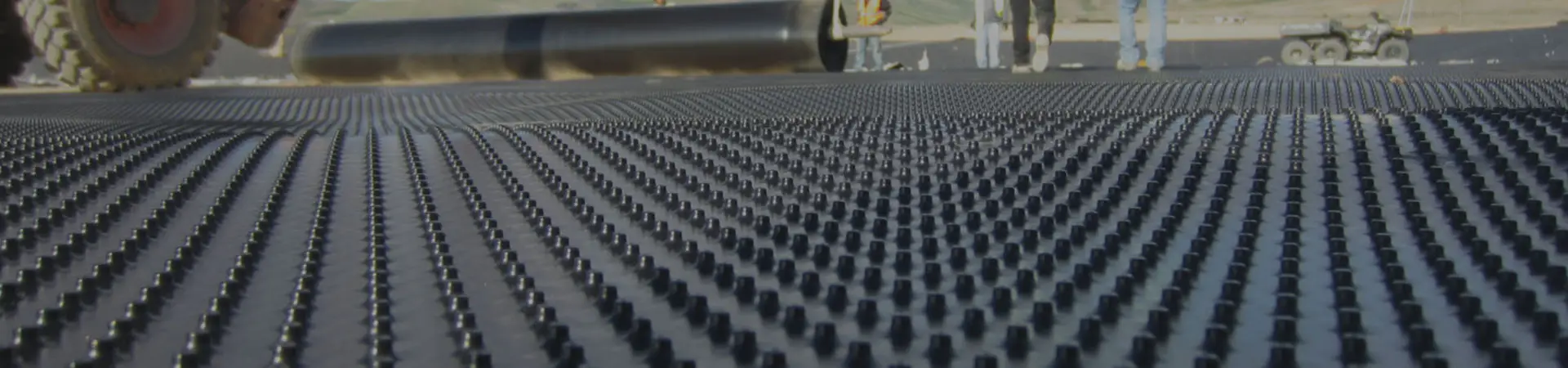
Longxiang New Materials presents its dimple sheet as a drainage board formed by pressing plastic into closed protruding cylindrical shells, which creates a concave-convex film and a three-dimensional molded core for subsurface drainage, as shown on its drainage board page. In the same product family, the board is paired with a geotextile filter layer so water can pass while soil is held back, a standard 2-part setup in this category as of 2026.
The support structure is built to maintain continuous three-dimensional drainage space. As of 2026, Longxiang states that the support height can withstand long-term high pressure without deformation, which is exactly the point of a drainage board in buried conditions.
It works as both drainage layer and protection layer.
That dual role matters on real jobs. A dimple board installed against a wall is there to relieve hydrostatic pressure, preserve the drainage cavity, and shield the waterproofing membrane from backfill damage, which lines up with the drainage geocomposite function shown on Longxiang’s composite drainage net page.
Product Construction and Material
The physical build is simple but important: a 3D molded plastic core creates the void space, and a geotextile layer acts as the filter. Longxiang’s drainage board product listing shows this composite structure clearly, with the plastic sheet forming the concave-convex pattern that keeps water moving instead of letting the wall sit against wet soil.
A flat sheet would not do the same job. The molded shell pattern is what preserves structural integrity and leaves a drainage path in place after installation, which is the whole reason contractors use a drainage board rather than a plain protection layer.
Application Areas and Benefits
The first and most practical use is foundation drainage. In that role, the board sits behind the wall as a foundation drainage mat, protects the waterproofing membrane, and channels water away before pressure builds, matching the companion-wall-drainage function described by J-Drain for foundation walls.
It is not a standalone waterproofing membrane.
That distinction matters because dimple board waterproofing is really a two-part assembly in most wall applications: the membrane stops water entry, and the drainage layer reduces pressure and gives water a path down to collection. Longxiang’s own product positioning fits that use, and the same logic carries into interior and below-grade applications described on J-Drain’s interior foundation page.
Beyond foundations, Longxiang places the same drainage-board concept into subsurface drainage work across roads, ditches, slope protection, landfill, mining, coastal engineering, agriculture, and aquaculture. Its case study section reflects the wider civil-engineering use that buyers expect from export-focused geosynthetics suppliers as of 2026.
In field terms, the benefits are straightforward. The sheet creates an air-and-water pathway, eases hydrostatic pressure against buried structures, and adds a sacrificial layer between the wall system and sharp or compacted backfill.
Foundation Drainage Solutions
For foundation walls, the product acts as a foundation drainage mat that sits outside the structural wall and in front of the backfill. That setup helps protect the waterproofing membrane during placement and service life, while giving infiltrating water a controlled route downward instead of letting it press directly against the wall.
Height and load change the choice. A short residential wall and a deep commercial wall do not ask the same thing from a drainage board, so contractors need to match the board to the wall condition rather than treating every dimple sheet as interchangeable in 2026.
Performance Specifications and Benchmarking
This is the section buyers usually want first, and it is also where Longxiang is leanest in public detail. As of 2026, Longxiang does not publish numeric thickness, compressive strength, or flow-rate figures for its drainage board on the public product pages, so a buyer cannot fully size the product from web copy alone.
That does not make the product unusable. It just means the contractor or importer needs to request the exact build, load expectation, and drainage requirement before ordering, especially for taller walls, heavier backfill, or projects where inspector signoff depends on named test standards.
For industry context, one recognized benchmark in the same product class is J-Drain 400RB. Its published brochure lists compressive strength at 15,000 psf per ASTM D-1621 and water flow rate at 250 gal/min/ft per ASTM D4491, as shown in the J-Drain 400RB brochure.
Selection is never one-size-fits-all. The right drainage board depends on wall height, earth load, expected water volume, and how the board is being used in relation to the waterproofing layer, which is the same performance logic reflected in J-Drain’s master specification and ICC-ES ESR-1901 AC243 acceptance documentation.
Industry Benchmark Specifications
Here is the clean side-by-side performance context contractors usually want before sending an RFQ.
| Product reference | Compressive strength | Water flow rate | Test basis | Public note |
|---|---|---|---|---|
| Longxiang New Materials drainage board | Not publicly listed as of 2026 | Not publicly listed as of 2026 | Not publicly listed | Requires direct inquiry |
| J-Drain 400RB | 15,000 psf | 250 gal/min/ft | ASTM D-1621, ASTM D4491 | Published benchmark |
Public benchmark numbers help frame expectations.
Longxiang’s limitation here is simple: the public page does not give the numeric values many engineers want upfront. The upside is that factory-direct buyers can ask for the exact construction and application fit instead of trying to reverse-engineer a generic listing.
Competitor coverage tells a similar story across the broader field. bpmgeosynthetics, jrxgeo, glgeosynthetics, antgeo, bmcic, sinogeosyn, geoace, geomembrane, agruamerica, and geosynthetics all overlap with Longxiang New Materials in civil and environmental geosynthetics, but their catalogs vary in breadth, drainage focus, and how much project-level detail is easy to pin down on a first pass; geomembrane is narrower around containment, agruamerica operates at larger scale, and geosynthetics is more distributor-oriented, while Longxiang keeps a broad factory-direct product range that includes drainage board alongside geomembranes, geotextiles, GCLs, geogrids, geocells, and erosion-control materials as of 2026.
Ordering, Customization, and Export Information
Longxiang New Materials supports ODM and OEM customization for drainage boards, including color variants, which matters for importers handling private-label programs or projects with package-level identification needs. The company’s broader About page and main site position it as a cost-effective, factory-direct geosynthetics supplier with broad product coverage and export capability.
Pricing is not posted publicly, and detailed specs are handled by direct inquiry because the order depends on customization, intended use, and shipping requirements. That is a limitation if you want a click-to-buy checkout, but it is normal for B2B drainage products that change by roll size, configuration, and destination market.
The bigger advantage is consolidation. Longxiang does not just sell a drainage board in isolation, and its product catalog shows a lineup that can support the surrounding system on infrastructure and containment jobs, from geotextiles to geomembranes to other drainage-related materials.
Request for Quote (RFQ) Checklist
A good RFQ saves days of back-and-forth. For a Longxiang dimple sheet inquiry in 2026, buyers should include the exact application area, such as foundation drainage, protection layer use, or companion layer for a waterproofing system.
Roll dimensions should be stated clearly, along with any customization needs, including color or build preference. Export buyers should also confirm destination logistics and any compliance or documentation requirements with Longxiang sales before the order is finalized.
How do I ask Longxiang New Materials for pricing?
Price is handled by direct inquiry rather than a posted rate card, because the drainage board can be customized and export terms change by order. The useful move is to send application, roll dimensions, destination, and any color or OEM request in the first message.
Can Longxiang New Materials customize drainage boards?
Yes. As of 2026, Longxiang supports ODM and OEM customization, including color variants, which is useful for branded imports and project-specific supply programs.
What should I confirm before placing an export order?
Confirm the intended use, requested roll format, destination shipping details, and any compliance paperwork needed at the receiving end. That gives Longxiang’s sales team enough to match the product build and prepare the export side properly.
Is a dimple sheet the same as waterproofing?
No. A dimple sheet is a drainage and protection layer, while the waterproofing membrane is the actual water barrier in a wall assembly.
How do you choose the right drainage board?
Start with wall height, expected load, and water volume. Then check whether the board is being used for foundation drainage, membrane protection, or as part of a larger drainage composite.
Choosing the right fit
The smartest way to pick a dimple board is to start with the job, not the catalog. If you need fast public numbers for submittal comparison, use benchmark specs to set the target, then ask Longxiang New Materials for the exact configuration that matches your wall height, load, and export requirements.
If your project needs a factory-direct supplier with broad geosynthetics coverage, customization, and the ability to support drainage products alongside related materials, Longxiang New Materials makes a strong practical choice. If you need every performance number posted before the first inquiry, treat the public page as a starting point and make the RFQ do the real work.
Drainage Board / Dimple Sheet FAQs
1) What is a drainage board (dimple sheet)?
Drainage boards (dimpled drainage boards) are manufactured from high-density polyethylene (HDPE) through a stamping process. Their surfaces feature a regularly arranged pattern of dimples, which effectively isolate the soil and create a permanent, continuous drainage space, thereby providing exceptional waterproofing, anti-seepage, and water-conducting capabilities.
2) Where is dimple sheet used in construction?
It is widely applied in the landscaping of basement roof slabs, waterproofing of basement exterior walls, roof gardens, the base slabs of road and railway tunnels, and various retaining wall drainage projects; it effectively alleviates water pressure and protects the main building structure from groundwater erosion.
3) What thickness and compressive strength should I choose?
Product selection should be determined based on the project's depth and load requirements. For standard basement walls, products with a stud height of 10–20 mm are typically used. However, if the backfill is particularly deep or the roof slab is subject to heavy loads (such as those imposed by landscaping or planting), it is recommended to select drainage boards made from virgin material—characterized by high gram weight and high compressive strength—to prevent deformation.
4) Does drainage board replace a drainage composite?
Dimpled drainage boards typically require pairing with geotextiles to achieve optimal filtration and drainage results. In contrast, composite drainage materials—such as drainage boards laminated with geotextiles—constitute integrated products. In specific light-load applications or spaces dedicated solely to water conveyance, drainage boards may be utilized as a standalone alternative.
5) How do you install dimple sheet on basement walls?
Wall installation must proceed from the bottom up, with the dimples facing the wall surface. Secure the material using specialized insulation anchors or shot-fired fasteners fitted with washers. Overlapping sections should be sealed using double-sided tape or heat welding, and the top edge must be secured and sealed with a finishing strip to prevent silt and debris from entering the drainage channels.
6) What is the difference between HDPE dimple sheet and other plastics?
Compared to ordinary plastics, high-quality, brand-new HDPE material exhibits superior chemical stability, excellent resistance to acid and alkali corrosion, high tensile and compressive strength, and strong puncture resistance. It is highly resistant to aging and degradation in harsh, damp underground environments, ensuring an engineering service life of over fifty years.
Main Products

PROJECT CASES
APPLICATION AREAS
Geotechnical material series are widely used in various fields such as highways, railways, tunnels, water conservancy of reservoirs and canals, artificial lakes, environmental protection, sewage treatment, landfills, anti-seepage of tailings reservoir areas, and livestock breeding.
Water conservancy projects
Geosynthetics play a vital role in water conservancy projects such as dams and reservoirs, canals and channels, and riverbank protection.
Breeding industry
In the aquaculture industry, geosynthetics such as geomembranes and geotextiles can be used to create healthy aquaculture ponds, ensure stable water quality and reduce water resource consumption. All geosynthetics provided by can be customized according to customer needs.
Road construction
The geosynthetics such as geomembranes, geotextiles, geogrids, geocells, etc. provided by play an irreplaceable role from roadbed treatment to pavement protection, from drainage systems to environmental protection isolation.
Agricultural
In agricultural irrigation and biogas digester scenarios, geosynthetics such as geomembranes and geotextiles play a key role due to their respective characteristics. The products provided by Factory meet the standards and can be customized according to requirements.
Coastal Engineering
In coastal engineering, geosynthetics such as geobags, cement blankets, and geogrids play an important role in coastal engineering from coastal protection, structural reinforcement to slope stability, and effectively respond to the challenges brought by the complex geology and environment of coastal areas.
Environmental Protection
Factory provides customers with high-standard geosynthetics to meet their needs for building landfills.
LISTEN & DELIVER TRUSTED SOIUTIONS.
FAQ

undefined
GET A FREE QUOTE
CONTACT US
Email : longxiang@lxgeosynthetics.com
Add : Room 2416, Building 6, China Resources Landmark Plaza, Lixia District, Jinan City, Shandong, China Province
GET A FREE QUOTE
Copyright 2025 : Shandong Longxiang New Materials Co., Ltd. Privacy Policy