Shandong Longxiang New Materials Co., Ltd.
Standard Certified By

Filtration Geotextiles for Drainage: Spec-Driven Selection and Custom Solutions
Classification :
PRODUCT DETAILS
Picking filtration geotextiles gets messy fast when the real question is not “woven or nonwoven,” but which geotextile filter fabric will hold back fines without choking off flow. Engineers usually end up balancing soil retention, drainage rate, puncture toughness, and install damage at the same time, which is exactly where a spec-driven approach matters more than a broad catalog.
That is also where Longxiang New Materials stands out: not by vague claims, but by giving engineers a usable range of nonwoven and woven options for geotextile filtration and drainage applications, plus custom production support when standard rolls are not the right fit.
Quick answer: For subsurface drainage, FHWA identifies filtration and drainage as critical geotextile applications in transportation work, and the key selection metrics are AOS, permittivity, and flow rate (FHWA).
Longxiang New Materials’ PP long fiber nonwoven filtration geotextiles run from 10 0 to 1200 g/m², with customizable roll lengths up to 300 m and tensile values increasing with weight.
AASHTO M288-24 sets survivability classes for subsurface drainage geotextiles, while integrated drainage composites can pair filter fabric with a geonet core for combined flow and separation.
filtration geotextiles: purpose and key properties
Filtration geotextiles sit between soil and a drainage path, and their job is simple to say but tricky to get right: keep soil where it belongs and let water keep moving. In transportation work, filtration and drainage are identified as critical geotextile applications by the FHWA and the Geotextile Engineering Manual listing from the Transportation Research Board/FHWA (TRB/FHWA).
AASHTO M288-24 defines standards and survivability classifications for subsurface drainage geotextiles, which matters because the same fabric that performs well in lab flow conditions still has to survive delivery, placement, and cover installation (AASHTO note). That survivability piece is where engineers often narrow choices quickly, especially when a drainage trench or aggregate layer is rough on the fabric.
Three numbers tend to drive early selection for geotextile filtration: apparent opening size, permittivity, and flow rate. AOS governs how much soil can pass, permittivity tells you how easily water moves through the sheet, and flow rate helps translate that into field drainage behavior.
Filtration is not just about flow.
It is about stable flow.
why filtration matters in geotextile function
A filtration layer has to retain soil fines to maintain soil stability while still allowing controlled drainage flow, and that balance is the whole point of geotextiles for drainage. If the openings are too large, the soil structure starts to unravel into the drain path; if they are too tight or the fabric clogs, water backs up and the drainage system loses capacity.
That is why soil gradation and clogging risk belong in the first conversation, not the last one. A geotextile filter fabric is doing two jobs at once, and it fails the application if it only does one of them well.
nonwoven vs woven filtration geotextiles: trade-offs
The easiest split is this: woven filtration geotextile options are usually chosen when strength leads the brief, while nonwovens are usually chosen when filtration and drainage behavior matter most. That rule is not absolute, but it is a useful place to start before you get into project-specific AOS and permittivity targets.
Here is the side-by-side that matters for drainage selection:
| Type | Material | Stated range | Main strength | Main limitation |
|---|---|---|---|---|
| Woven geotextile | PP and PET | Up to 300 kN/m tensile strength | High structural strength for load-focused applications | Usually less forgiving as a drainage filter layer |
| Nonwoven long fiber geotextile | PP | 100 to 1200 g/m² | Better filtration and drainage performance | Heavy grades can be more fabric than light-duty filters need |
| Heavy-duty nonwoven | PP | Higher-mass nonwoven configurations | Better puncture resistance and cushioning | Added mass may be unnecessary for simpler drainage work |
Woven PP and PET geotextiles reach tensile strengths up to 300 kN/m, which makes them attractive where reinforcement or structural stability is carrying more weight in the design. The trade-off is that a woven product can be less ideal where the heart of the job is geotextile filtration rather than pure strength.
Nonwoven PP long fiber geotextiles cover 100 to 1200 g/m² and are the more natural fit for filtration and drainage functions, especially where the system needs cushioning and puncture resistance along with water passage. Heavy nonwovens usually gain strength and installation toughness as mass rises, but they can overshoot the needs of light-duty drainage filters and add cost and thickness without much return.
That distinction is also a good lens for reading the broader market. bpmgeosynthetics, btlliners, hyhdpemembrane, solmax, geosyn, tinhygeosynthetics, ecogeox, geosynthetics.com, geosynthetics.net, geosynthetics.org, geosyntheticsmagazine, and geosyntheticsconference all show how crowded this space is, but not all of them help an engineer move from product category to project-ready filtration spec. Some sell broad material ranges, some focus more on liners or mixed geosynthetic systems, and some are information or event platforms rather than product manufacturers, which is exactly why a spec-led product page has more practical value than a generic directory.
Longxiang New Materials nonwoven filtration fabrics
Within that nonwoven lane, Longxiang New Materials offers PP long fiber nonwoven geotextiles from 100 to 1200 g/m², with customizable roll lengths up to 300 m through its nonwoven geotextile range. For engineers trying to match roll handling, trench layout, and installation speed, that production flexibility matters just as much as the headline material type.
Strength scales in a way that is easy to read. Ultimate tensile strength rises with weight and reaches 28 kN/m at 600 g/m², while grab tensile strength spans 270 N to 1720 N across the 100 to 600 g/m² range.
Those numbers make one limitation clear too: the higher-mass grades are not automatically the smart choice for every drain. If the application is a lighter-duty edge drain or filter wrap, a heavy nonwoven may add toughness you do not actually need.
advanced drainage solutions with composite geotextiles
Sometimes a single sheet is not the cleanest answer, especially where water has to move laterally after passing through the filter. In those cases, a composite product can handle filtration and conveyance in one assembly.
Longxiang New Materials’ HDPE 3D composite drainage net combines geotextile filtration fabric with geonet drainage layers. That build is meant to keep soil fines out of the drainage core while preserving a dedicated flow path inside the composite.
The product is described as meeting AASHTO M288-00 drainage requirements, which puts it squarely in the discussion for engineered drainage systems where a simple wrapped aggregate section may not be the cleanest install. The obvious limitation is design specificity: composite drainage nets are more specialized than a plain nonwoven sheet, so they are best used where the project actually needs both filtration and in-plane drainage in the same component.
market trends and demand drivers
The demand picture helps explain why nonwoven filtration geotextiles keep showing up in specs. The global drainage geotextiles market was valued at USD 1,147.8 million in 2024, with a 6.7% CAGR projected through 2030 (Grand View global).
In the U.S., the geotextile market reached USD 1.01 billion in 2024, and the projected CAGR for 2025 through 2030 is 4.1% (Grand View U.S.). That slower but steady growth rate usually points to mature infrastructure demand, where drainage, separation, and rehabilitation work keep moving even when project mixes change.
Nonwoven geotextiles hold 51.5% market share, driven largely by filtration and drainage uses (market share report). That number fits what engineers already see in the field: if the job centers on moving water while keeping fines under control, nonwoven products often end up at the front of the shortlist.
choosing the right Longxiang New Materials filtration geotextile
The cleanest way to choose a Longxiang New Materials filtration geotextile is to start with the soil, then the drainage duty, then the installation abuse you expect the fabric to take. That order keeps you from overbuying tensile strength when the real problem is clogging risk, or overbuying mass when a lighter filter layer would drain fine and install faster.
FHWA guidance recommends thick nonwovens for subbase soils with high fines because they improve filtration and in-plane drainage behavior in those conditions. That is a strong clue for projects where migration of fines is more threatening than headline tensile demand.
Here is a practical selection path:
| Project condition | What matters most | Sensible product direction | Watch-out |
|---|---|---|---|
| High-fines subbase soil | Soil retention and clogging control | Thicker nonwoven filtration fabric | Too-open AOS can lose fines |
| Load-focused application with filtration as a secondary need | Tensile capacity | Woven PP or PET option | Strength-first fabrics may not be the best filters |
| Drainage layer needing cushioning | Puncture resistance and water passage | Nonwoven PP long fiber | Overly heavy fabric can be excessive |
| Need filtration plus internal flow path | Combined filtration and drainage | Composite drainage net | More specialized design and detailing |
Longxiang New Materials offers customized filtration geotextiles, but the exact AOS, permittivity, and flow rate values need direct inquiry based on the application and soil. That is not unusual in this category, but it does mean the engineer should ask for the exact submittal package before locking the spec.
A useful plus here is documentation. Longxiang New Materials provides downloadable QA and submittal materials through its product resources and technical pages, which helps with compliance checks and approval workflows instead of leaving the design team to chase paperwork late in the process.
FAQ
1.How to specify by soil and filtration factors
Soils with high fines generally need lower AOS geotextiles for better soil retention. That is the first screen, because a fabric that is too open can turn a drainage detail into a soil-loss detail.
Permittivity changes how quickly water moves through the geotextile and affects clogging risk at the same time. Heavier nonwovens tend to have lower permittivity, so the safer choice for puncture or cushioning is not automatically the better choice for through-flow.
The best spec work pairs soil gradation with target filtration behavior instead of picking by fabric name alone. For a drainage trench, underdrain, or subbase filter, that usually means asking one plain question first: what is the soil trying to do when it gets wet?
2.Does Longxiang New Materials list AOS and permittivity on the product page?
The product range is customizable, but exact AOS, permittivity, and flow rate values need direct inquiry for the specific fabric and application. That is the point where the submittal package matters.
3.What Longxiang New Materials nonwoven weights are available?
The PP long fiber nonwoven line runs from 100 to 1200 g/m². Roll lengths can be customized up to 300 m.
4.Is there a Longxiang New Materials option for combined filtration and drainage?
Yes. The HDPE 3D composite drainage net pairs a filter fabric with geonet drainage layers for systems that need both filtration and in-plane flow.
5.Are nonwovens always better for geotextile filtration?
No. Nonwovens are usually favored for filtration and drainage, but woven products still make sense when tensile strength is the lead requirement.
6.How do soil fines affect geotextile filter fabric choice?
High-fines soils usually call for a lower AOS to improve soil retention. The clogging risk then has to be checked against permittivity so water can still pass through the fabric.
Longxiang New Materials makes the most sense when your decision starts with performance targets, not product labels. If the project is driven by filtration behavior, fines retention, and drainage flow, start with nonwoven options and ask for the exact AOS and permittivity package; if structural demand dominates, look at woven strength first; if the section needs both filtration and a built-in flow path, move to the composite format.
Related Geosynthetic Materials
Geotextiles play a fundamental role when integrated with other geosynthetic materials to ensure long-term structural integrity in various engineering projects. In many civil applications, these fabrics are often paired with high-performance geomembranes to provide both mechanical protection and effective fluid containment. For instance, using a non-woven geotextile as a protective cushion for an HDPE geomembrane significantly reduces the risk of liner punctures in landfill or mining sites. In specific scenarios where a pre-bonded solution is required, a composite geomembrane offers the integrated benefits of both filtration and impermeability. Selecting the appropriate material combination is essential for meeting rigorous international standards and ensuring the durability of the infrastructure. Our technical team is ready to help you determine the optimal material configuration for your specific environmental and construction needs.
Common geotextile functions
-
Separation
-
Filtration
-
Drainage
-
Reinforcement
Geotextiles FAQs
1) What are geotextiles used for?
Geotextiles primarily serve five key functions: separation, filtration, drainage, reinforcement, and erosion control. They are widely utilized in highway subgrade reinforcement, railway construction, the encapsulation of retaining wall backfill, riverbank protection, and basement drainage systems, thereby extending the service life of engineering projects and reducing maintenance costs by optimizing soil structure.
2) What's the difference between woven and nonwoven geotextiles?
The fundamental difference lies in their functional emphasis: Woven geotextiles are fabricated by weaving fibers and possess high tensile strength, making them suitable for heavy-load applications such as soft ground reinforcement and embankment engineering. Non-woven geotextiles, produced via a needle-punching process, exhibit superior permeability and are primarily utilized for drainage in blind drains, filtration behind retaining walls, and the protection of impermeable membranes.
3) How do I choose the right geotextile (GSM/oz, permittivity, AOS)?
Engineers typically select materials based on five key metrics—basis weight (GSM/oz), Apparent Opening Size (AOS), water permeability, tensile strength, and CBR puncture strength—to ensure the material meets the project's load-bearing and drainage requirements.
4) Can geotextiles be used for drainage and filtration together?
Yes, needle-punched non-woven geotextiles possess excellent composite properties. Acting as a filtration layer, they prevent the loss of fine soil particles; simultaneously, their internal three-dimensional structure efficiently channels and drains water in the planar direction. Consequently, they are widely utilized in various underground anti-siltation and drainage systems.
5) Do geotextiles meet common standards (ASTM/ISO) and how do you provide QA?
Our products strictly adhere to international ASTM and ISO standards. We maintain oversight through a comprehensive, end-to-end QA/QC system; prior to shipment, every product batch undergoes rigorous testing for tensile strength, pore size, and water permeability, accompanied by third-party inspection reports. Furthermore, we offer customized R&D services to meet specific mechanical performance requirements based on engineering drawings.
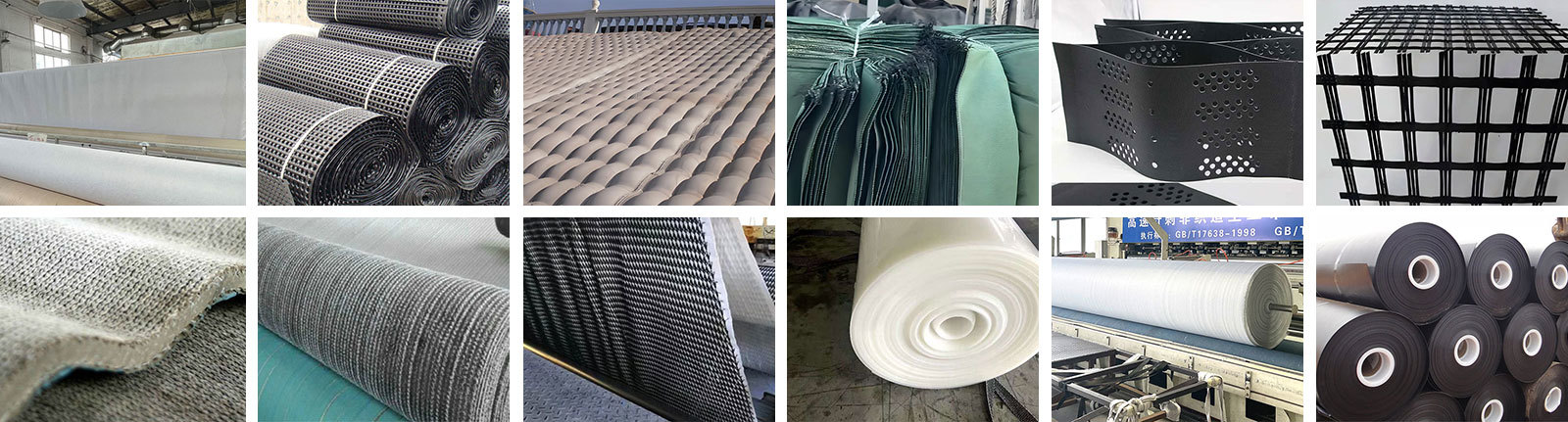
Main Products
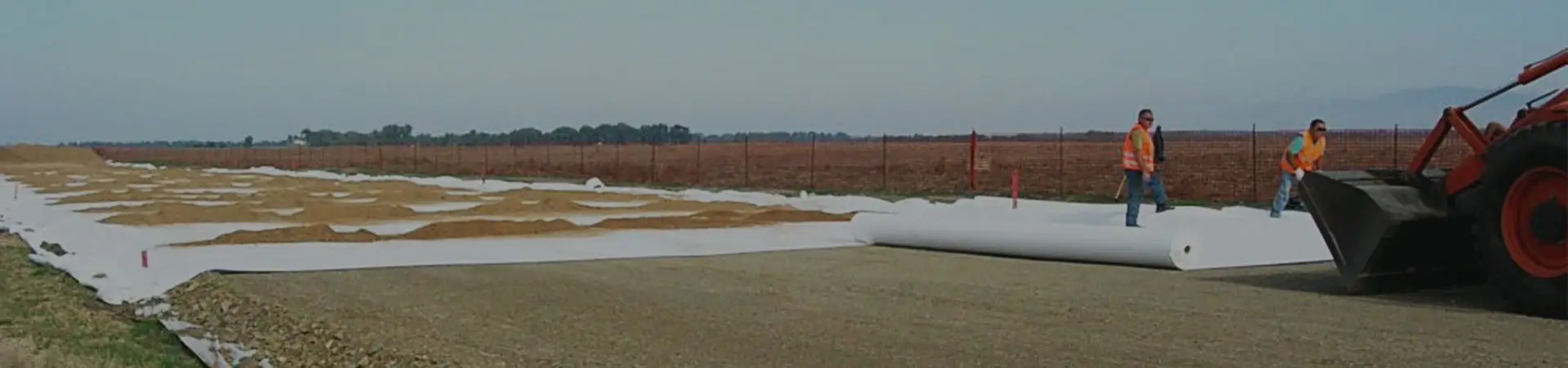
PROJECT CASES
APPLICATION AREAS
Geotechnical material series are widely used in various fields such as highways, railways, tunnels, water conservancy of reservoirs and canals, artificial lakes, environmental protection, sewage treatment, landfills, anti-seepage of tailings reservoir areas, and livestock breeding.
Water conservancy projects
Geosynthetics play a vital role in water conservancy projects such as dams and reservoirs, canals and channels, and riverbank protection.
Breeding industry
In the aquaculture industry, geosynthetics such as geomembranes and geotextiles can be used to create healthy aquaculture ponds, ensure stable water quality and reduce water resource consumption. All geosynthetics provided by can be customized according to customer needs.
Road construction
The geosynthetics such as geomembranes, geotextiles, geogrids, geocells, etc. provided by play an irreplaceable role from roadbed treatment to pavement protection, from drainage systems to environmental protection isolation.
Agricultural
In agricultural irrigation and biogas digester scenarios, geosynthetics such as geomembranes and geotextiles play a key role due to their respective characteristics. The products provided by Factory meet the standards and can be customized according to requirements.
Coastal Engineering
In coastal engineering, geosynthetics such as geobags, cement blankets, and geogrids play an important role in coastal engineering from coastal protection, structural reinforcement to slope stability, and effectively respond to the challenges brought by the complex geology and environment of coastal areas.
Environmental Protection
Factory provides customers with high-standard geosynthetics to meet their needs for building landfills.
LISTEN & DELIVER TRUSTED SOIUTIONS.
FAQ

undefined
GET A FREE QUOTE
CONTACT US
Email : longxiang@lxgeosynthetics.com
Add : Room 2416, Building 6, China Resources Landmark Plaza, Lixia District, Jinan City, Shandong, China Province
GET A FREE QUOTE
Copyright 2025 : Shandong Longxiang New Materials Co., Ltd. Privacy Policy