Shandong Longxiang New Materials Co., Ltd.
The Ultimate Guide to Geosynthetic Clay Liners (GCLs): Applications and Key Benefits in Modern Engineering
Release time:
2025-12-10
Discover the top applications of Geosynthetic Clay Liners (GCLs) in waste management, mining, and water containment. Learn why GCLs offer superior, cost-effective, and self-healing waterproofing compared to traditional compacted clay.
Introduction
In the realm of modern civil engineering and environmental protection, the demand for reliable, cost-effective, and high-performance hydraulic barriers is higher than ever. Among the various geosynthetic solutions available, Geosynthetic Clay Liners (GCLs) have emerged as a top-tier choice for engineers and contractors worldwide.
But what exactly makes GCLs superior to traditional compacted clay, and where can they be effectively applied? In this article, we explore the versatility of GCLs and why they are the preferred solution for containment projects.
What is a Geosynthetic Clay Liner (GCL)?
Before diving into applications, it is essential to understand the composition. A Geosynthetic Clay Liner is a factory-manufactured hydraulic barrier consisting of a layer of low-permeability sodium bentonite sandwiched between two geotextiles (usually a non-woven and a woven layer). These layers are typically needle-punched or stitched together to ensure structural integrity.
When hydrated, the bentonite swells to form a low-permeability clay layer, providing excellent containment properties equivalent to several feet of compacted clay.
Top 4 Applications of Geosynthetic Clay Liners
GCLs are versatile and can be used in a wide range of environmental and geotechnical projects. Here are the most critical applications:
1. Waste Management (Landfills)
The most common application for GCLs is in the waste management sector. They serve as a critical component in both:
Base Liners: Preventing hazardous leachate from contaminating groundwater.
Landfill Capping: Acting as a cover to prevent rainwater infiltration into the waste mass, thereby reducing leachate generation.
Compared to traditional clay liners, GCLs occupy less airspace, allowing for more waste storage volume—a direct economic benefit for landfill operators.
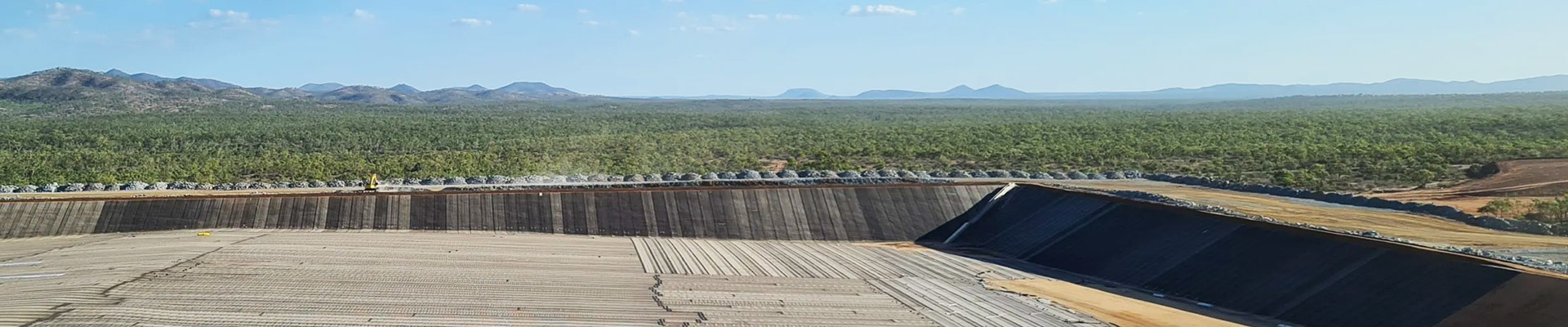
2. Mining and Tailings Containment
The mining industry faces strict environmental regulations regarding the storage of tailings and chemical solutions. GCLs are extensively used in:
Heap leach pads.
Tailings dams.
Process solution ponds.
Their high shear strength and resistance to chemical degradation make them ideal for the harsh conditions often found in mining sites.
3. Water Conservation and Infrastructure
Water is a precious resource, and minimizing seepage is vital. GCLs act as effective waterproofing barriers for:
Canals and Stormwater Channels: Preventing water loss during transport.
Artificial Lakes and Decorative Ponds: Maintaining water levels in recreational areas.
Dams and Dykes: reinforcing the impermeable core of earth dams.
4. Transportation and Civil Infrastructure
Beyond containment, GCLs are used in roadways, railways, and tunnels. They provide:
Secondary Containment: protecting soil from accidental spills on highways.
Waterproofing: Preventing groundwater from seeping into tunnels or basements.
Environmental Protection: Lining stormwater retention ponds along highways.

Why Choose GCLs Over Traditional Compacted Clay?
If you are a project manager deciding between imported clay and GCLs, consider these distinct advantages:
Self-Healing Capabilities: The sodium bentonite has unique swelling properties. If the liner is punctured or damaged during installation, the clay swells to seal around the intrusion, maintaining the hydraulic seal.
Ease of Installation: GCLs are heavy but come in rolls, making them much faster to deploy than hauling and compacting tons of earth. This significantly reduces construction time and labor costs.
Consistent Quality: Unlike soil, which varies by location, GCLs are manufactured in a controlled environment, ensuring uniform hydraulic conductivity across the entire project area.
Freeze-Thaw Resistance: GCLs can withstand freeze-thaw cycles better than compacted clay, which tends to crack under such conditions.
Conclusion
Geosynthetic Clay Liners represent the intersection of efficiency and environmental responsibility. Whether for a municipal landfill, a mining operation, or a water reservoir, GCLs offer a robust, self-healing, and cost-effective barrier solution.
Looking for high-quality GCLs for your next project? As a leading manufacturer of geosynthetics, we provide tailored GCL solutions to meet international standards (ASTM/ISO).
Contact Us Today to get a free quote or technical consultation for your specific engineering needs.
PROJECT CASES

CONTACT US
Email : longxiang@lxgeosynthetics.com
Add : Room 2416, Building 6, China Resources Landmark Plaza, Lixia District, Jinan City, Shandong, China Province
GET A FREE QUOTE
Copyright 2025 : Shandong Longxiang New Materials Co., Ltd. Privacy Policy