Shandong Longxiang New Materials Co., Ltd.
Standard Certified By

Heavy Duty PET/PP Woven Geotextile | High Tensile Strength (20kN - 100kN) for Civil Engineering
Classification :
PRODUCT DETAILS
1.Product Overview
Engineered for the most demanding civil engineering projects, our Heavy Duty Woven Geotextile series offers superior soil reinforcement and stabilization solutions. Available in both High-Tenacity Polypropylene (PP) and High-Modulus Polyester (PET) yarns, this fabric is designed to withstand high tensile loads ranging from 20kN/m up to 100kN/m (and higher upon request).
Whether you are reinforcing weak subgrades for highway construction or stabilizing steep embankments, our woven geotextiles provide the critical strength, low elongation, and durability required to extend the lifespan of your infrastructure.
2.Key Features
High Tensile Strength: Robust mechanical properties with strength grades of 20kN, 40kN, 60kN, 80kN, and 100kN/m.
Dual Material Options:
PP (Polypropylene): Excellent chemical resistance (acid/alkali) and cost-effectiveness.
PET (Polyester): Superior creep resistance and high modulus for long-term structural loads.
Low Elongation: Limits soil deformation under heavy stress, ensuring structural integrity.
Durability: UV-stabilized and resistant to biological degradation, rot, and naturally occurring soil chemicals.
Hydraulic Performance: Woven structure allows for controlled water permeability while preventing soil particle migration.
3.Technical Specifications
We offer a full range of specifications to meet ASTM and ISO standards.
| Property | Test Method | Unit | WG-40 (PP/PET) | WG-60 (PP/PET) | WG-80 (PP/PET) | WG-100 (PP/PET) |
|---|---|---|---|---|---|---|
| Tensile Strength (MD) | ASTM D4595 | kN/m | 40 | 60 | 80 | 100 |
| Tensile Strength (CD) | ASTM D4595 | kN/m | 40 | 60 | 80 | 100 |
| Elongation at Break | ASTM D4595 | % | < 15% | < 15% | < 12% | < 10% |
| CBR Puncture | ASTM D6241 | kN | 4.5 | 6.5 | 8.5 | 10.5 |
| UV Resistance (500h) | ASTM D4355 | % | > 70% | > 70% | > 70% | > 70% |
| Standard Roll Width | - | m | 3.8m - 6.0m | 3.8m - 6.0m | 3.8m - 6.0m | 3.8m - 6.0m |
(Note: Custom specifications are available based on project requirements.)
4.Which Material Should You Choose: PET vs. PP?
Understanding your project environment is key to selecting the right woven geotextile:
Choose PP Woven Geotextile (Polypropylene) when:
Your project involves standard soil stabilization (roads, driveways).
The soil environment is highly acidic or alkaline (pH > 10).
Cost-efficiency is a primary concern.
Choose PET Woven Geotextile (Polyester) when:
Creep Resistance is critical: Ideal for long-term reinforced slopes and retaining walls where the fabric acts as a structural element.
The project requires high tensile strength at very low elongation.
You are building on soft soils requiring immediate load-bearing support (e.g., embankments over peat).
5.Applications in Civil Engineering
Our high-strength woven geotextiles are widely used in:
Road & Railway Construction: Reinforcing the subgrade layer to prevent rutting and extend pavement life.
Basal Reinforcement: Supporting embankments over soft foundations (marshes, sludge ponds).
Retaining Structures: Functioning as the reinforcing element in Mechanically Stabilized Earth (MSE) walls and wrapped-face slopes.
Coastal Protection: Used in geotextile tubes and sandbags for erosion control and breakwaters.
Land Reclamation: Providing a stable separation layer for dredging and fill works.
6.Quality Assurance & Logistics
Direct Manufacturer: Produced in our ISO 9001 certified facility.
Third-Party Testing: SGS / TRI test reports available for each batch.
Packaging: Heavy-duty black PE film for UV protection during transport.
Export Capacity: Capable of shipping 50+ containers per month globally.
Ready to Reinforce Your Project?
Contact our engineering team for a technical consultation or a competitive price quote.
Related Geosynthetic Materials
Geotextiles play a fundamental role when integrated with other geosynthetic materials to ensure long-term structural integrity in various engineering projects. In many civil applications, these fabrics are often paired with high-performance geomembranes to provide both mechanical protection and effective fluid containment. For instance, using a non-woven geotextile as a protective cushion for an HDPE geomembrane significantly reduces the risk of liner punctures in landfill or mining sites. In specific scenarios where a pre-bonded solution is required, a composite geomembrane offers the integrated benefits of both filtration and impermeability. Selecting the appropriate material combination is essential for meeting rigorous international standards and ensuring the durability of the infrastructure. Our technical team is ready to help you determine the optimal material configuration for your specific environmental and construction needs.
Common geotextile functions
-
Separation
-
Filtration
-
Drainage
-
Reinforcement
Geotextiles FAQs
1) What are geotextiles used for?
Geotextiles primarily serve five key functions: separation, filtration, drainage, reinforcement, and erosion control. They are widely utilized in highway subgrade reinforcement, railway construction, the encapsulation of retaining wall backfill, riverbank protection, and basement drainage systems, thereby extending the service life of engineering projects and reducing maintenance costs by optimizing soil structure.
2) What's the difference between woven and nonwoven geotextiles?
The fundamental difference lies in their functional emphasis: Woven geotextiles are fabricated by weaving fibers and possess high tensile strength, making them suitable for heavy-load applications such as soft ground reinforcement and embankment engineering. Non-woven geotextiles, produced via a needle-punching process, exhibit superior permeability and are primarily utilized for drainage in blind drains, filtration behind retaining walls, and the protection of impermeable membranes.
3) How do I choose the right geotextile (GSM/oz, permittivity, AOS)?
Engineers typically select materials based on five key metrics—basis weight (GSM/oz), Apparent Opening Size (AOS), water permeability, tensile strength, and CBR puncture strength—to ensure the material meets the project's load-bearing and drainage requirements.
4) Can geotextiles be used for drainage and filtration together?
Yes, needle-punched non-woven geotextiles possess excellent composite properties. Acting as a filtration layer, they prevent the loss of fine soil particles; simultaneously, their internal three-dimensional structure efficiently channels and drains water in the planar direction. Consequently, they are widely utilized in various underground anti-siltation and drainage systems.
5) Do geotextiles meet common standards (ASTM/ISO) and how do you provide QA?
Our products strictly adhere to international ASTM and ISO standards. We maintain oversight through a comprehensive, end-to-end QA/QC system; prior to shipment, every product batch undergoes rigorous testing for tensile strength, pore size, and water permeability, accompanied by third-party inspection reports. Furthermore, we offer customized R&D services to meet specific mechanical performance requirements based on engineering drawings.

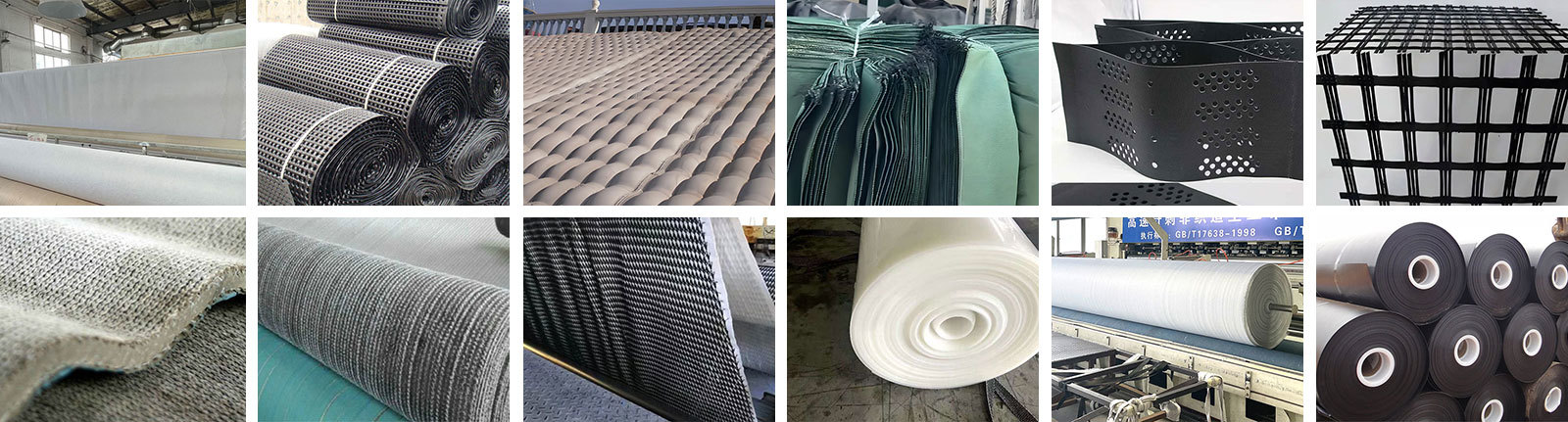
Main Products
PROJECT CASES
APPLICATION AREAS
Geotechnical material series are widely used in various fields such as highways, railways, tunnels, water conservancy of reservoirs and canals, artificial lakes, environmental protection, sewage treatment, landfills, anti-seepage of tailings reservoir areas, and livestock breeding.
Water conservancy projects
Geosynthetics play a vital role in water conservancy projects such as dams and reservoirs, canals and channels, and riverbank protection.
Breeding industry
In the aquaculture industry, geosynthetics such as geomembranes and geotextiles can be used to create healthy aquaculture ponds, ensure stable water quality and reduce water resource consumption. All geosynthetics provided by can be customized according to customer needs.
Road construction
The geosynthetics such as geomembranes, geotextiles, geogrids, geocells, etc. provided by play an irreplaceable role from roadbed treatment to pavement protection, from drainage systems to environmental protection isolation.
Agricultural
In agricultural irrigation and biogas digester scenarios, geosynthetics such as geomembranes and geotextiles play a key role due to their respective characteristics. The products provided by Factory meet the standards and can be customized according to requirements.
Coastal Engineering
In coastal engineering, geosynthetics such as geobags, cement blankets, and geogrids play an important role in coastal engineering from coastal protection, structural reinforcement to slope stability, and effectively respond to the challenges brought by the complex geology and environment of coastal areas.
Environmental Protection
Factory provides customers with high-standard geosynthetics to meet their needs for building landfills.
LISTEN & DELIVER TRUSTED SOIUTIONS.
FAQ

undefined
GET A FREE QUOTE
CONTACT US
Email : longxiang@lxgeosynthetics.com
Add : Room 2416, Building 6, China Resources Landmark Plaza, Lixia District, Jinan City, Shandong, China Province
GET A FREE QUOTE
Copyright 2025 : Shandong Longxiang New Materials Co., Ltd. Privacy Policy