Shandong Longxiang New Materials Co., Ltd.
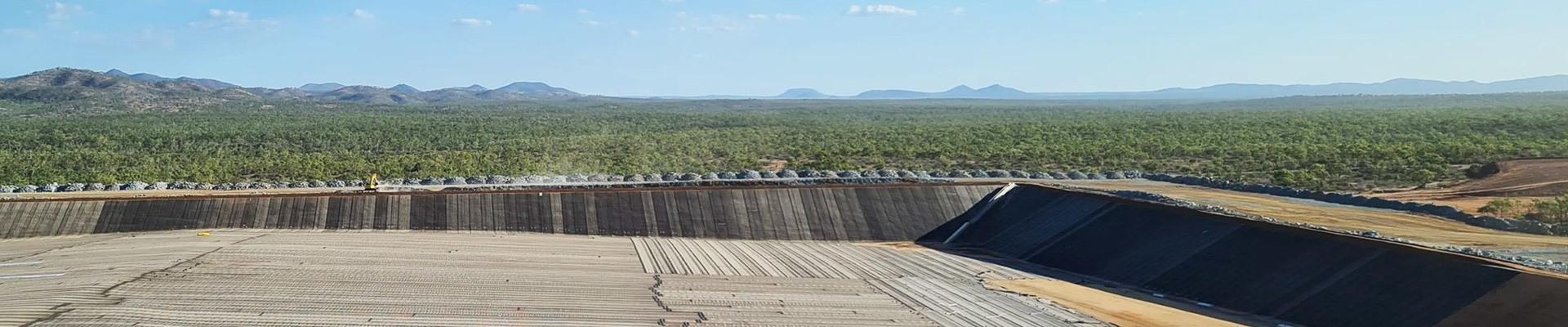
Regarding Geosynthetic Clay Liners (GCLs), do the montmorillonite content of the bentonite and the mass per unit area meet the required standards?
The natural sodium-based bentonite Waterproofing Geosynthetic Clay Liner (GCL) manufactured by Longxiang New Materials fully complies with—and exceeds—the requirements of the standards *Geosynthetic Clay Liners* (GB/T 27475-2011) and JG/T 193-2006.
Montmorillonite Content: We select high-purity natural sodium-based bentonite sourced from premium mining regions; the core montmorillonite content in our materials consistently meets or exceeds 85%, with a swelling index of ≥24 mL/2g. This fundamentally guarantees that, upon contact with water, the material will rapidly form a high-density, impermeable gel barrier.
Mass Per Unit Area: Our standard products feature a total mass per unit area of ≥4500 g/m² (of which the mass of the interlayer natural sodium-based bentonite granules is ≥4000 g/m²). We employ an advanced, fully automated needle-punching process to securely lock the bentonite in place; the high and uniform needle-punch density ensures that the bentonite granules remain absolutely stable—preventing any displacement or leakage—during both transportation and installation, thereby guaranteeing a 100% compliant waterproofing and anti-seepage performance.
Which antioxidants or UV stabilizers are added to your materials during the production process? What brands are used?
To ensure that our geomaterials achieve a service life of over 50 years—even when exposed to outdoor elements or buried in complex underground environments—Longxiang New Materials implements rigorous controls during production. In addition to strictly regulating carbon black content (maintained between 2.0% and 3.0%), we incorporate a high-specification blend of anti-aging additives:
Additive Composition: Adhering strictly to international GRI standards, we incorporate the full, prescribed proportions of Hindered Amine Light Stabilizers (HALS), primary antioxidants (such as 1010/1076), and secondary antioxidants (such as 168).
Additive Brands: We exclusively select additives from top-tier international and domestic chemical giants—such as BASF (formerly Ciba) and SI Group—to ensure the highest quality. This strategic choice enables our products to demonstrate exceptional performance in OIT (Oxidative Induction Time) testing under both high-pressure and atmospheric conditions. Furthermore, our products exhibit thermal aging retention rates and UV exposure retention rates that far exceed those of standard manufacturers, thereby guaranteeing that the material remains free from degradation even during prolonged exposure to sunlight throughout the construction phase.
How does the material perform in terms of resistance to low-temperature embrittlement in severe cold regions?
Longxiang New Materials’ products exhibit exceptional resistance to extreme cold and temperature fluctuations, making them ideally suited for engineering projects in high-altitude, frigid regions.
We utilize high-molecular-weight, high-performance virgin resins as our raw materials. Tested by authoritative national agencies, our HDPE geomembranes underwent low-temperature impact and embrittlement testing in extreme cold environments reaching -70°C; the material retained its superior flexibility, exhibiting absolutely no cracks, ruptures, or brittle fractures. Furthermore, the material demonstrates robust resistance to freeze-thaw cycles, effectively withstanding the shear stresses induced by the expansion and contraction of frozen ground layers during the cold season, thereby ensuring the long-term stability and operational integrity of seepage control systems in cold climates.
What are the puncture resistance strength and vertical permeability coefficient of Longxiang New Materials' products?
The geotechnical materials manufactured by Shandong Longxiang New Materials Co., Ltd. feature technical parameters that strictly meet or exceed national standards (e.g., GB/T 17643-2011, GB/T 17639-2008).
Puncture Resistance: Taking our commonly used 1.5mm HDPE geomembrane as an example, its CBR puncture resistance typically reaches ≥3500 N, demonstrating exceptional capability to withstand punctures caused by gravel and plant roots. Furthermore, the burst strength of our filament non-woven geotextiles significantly surpasses the industry average.
Vertical Permeability Coefficient:
Impermeable Materials (Geomembranes/Liners): The vertical permeability coefficient (water vapor transmission rate) is ≤1.0×10⁻¹³ g·cm/(cm²·s·Pa). In practical engineering applications, these materials are considered completely impermeable, offering outstanding anti-seepage performance.
Drainage and Permeable Materials (Filament Non-woven Geotextiles): The typical vertical permeability coefficient ranges from k × 10-1 to k × 10-3 cm/s. While withstanding high earth pressures, these materials ensure rapid vertical water flow, thereby effectively preventing soil erosion and loss.
How are your composite geomembranes manufactured? Does their peel strength meet national standards?
We utilize advanced thermal calendaring technology to laminate geotextiles and geomembranes. Unlike simple glue bonding, our heat-bonding process ensures a molecular-level integration between the layers.
Our composite geomembranes are engineered to exceed national and international standards (such as GB/T 17642). We maintain a peel strength ≥ 6N/cm (or higher depending on specific project requirements), ensuring that the layers will not delaminate even under high hydraulic pressure or during steep-slope construction.
What are the carbon black content and dispersion characteristics of the geomembrane?
This is a critical technical factor for exposed applications. Our geomembranes are formulated with a carbon black content ranging from 2.0% to 3.0%, which is the optimal window recommended by the GRI-GM13 standard for maximizing UV protection without compromising mechanical properties.
Regarding dispersion, we utilize advanced high-shear mixing technology to ensure that the carbon black is uniformly distributed throughout the polymer matrix. We categorize our carbon black dispersion according to the Category 1 or 2 rating (no large agglomerates or streaks), which guarantees that every square inch of the liner is shielded from photo-oxidation, effectively extending the service life of the project to over 50 years in typical buried or exposed conditions.
CONTACT US
Email : longxiang@lxgeosynthetics.com
Add : Room 2416, Building 6, China Resources Landmark Plaza, Lixia District, Jinan City, Shandong, China Province

GET A FREE QUOTE
Copyright 2025 : Shandong Longxiang New Materials Co., Ltd. Privacy Policy