Shandong Longxiang New Materials Co., Ltd.
Standard Certified By

Longxiang Foundation Drain Board: Engineered Drainage & Waterproofing Solution
Classification :
PRODUCT DETAILS
Water pushing against a below-grade wall is relentless, and a weak foundation drain board usually fails in two places first: it crushes under backfill or lets fines clog the drainage path. For builders sorting through drainage board, dimple board, and foundation drainage mat options, the real question is simple: will the wall keep draining after the excavation is closed up. Longxiang New Materials enters that conversation with a factory-direct, customizable system aimed at commercial and infrastructure jobs where fit, drainage space, and membrane protection all matter.
A foundation drain board is a drainage layer, not the waterproofing itself.
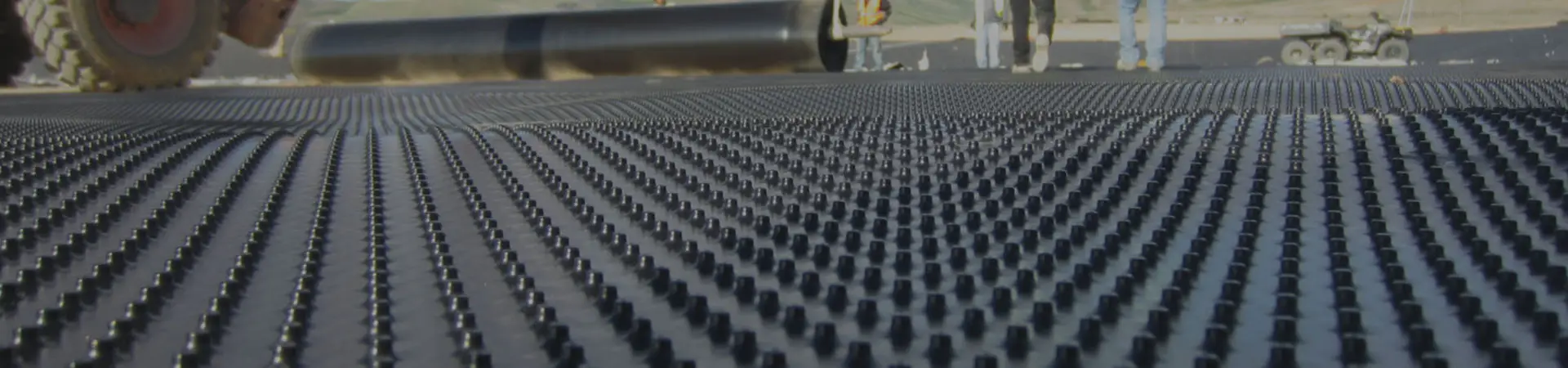
Longxiang New Materials offers a molded HDPE drainage board with a 3D concave-convex profile and typical stud heights of 10 to 20 mm, paired with a geotextile filter layer for water flow and soil retention (source). The 2024 IRC requires exterior footing drains at or below footing level, and one published comparison point in this category is J-Drain 400RB at 10.16 mm core thickness, 15,000 psf compressive strength, 21 gal/min/ft flow rate, and 140 gal/min/ft² fabric flow (source).
Product Overview and Design Features
Longxiang’s dimple board uses molded HDPE to create a continuous three-dimensional drainage space, with the concave-convex pattern acting like a permanent stand-off between soil and wall. In foundation work, that matters because drainage only happens if the void stays open after backfill pressure hits the assembly.
The composite build adds a geotextile filter layer that keeps surrounding soil from migrating into the drainage path while still allowing water to pass through (details here). That combination turns the board from a simple protection sheet into a working drain plane, which is the whole point behind a foundation drainage mat.
Stud height typically falls in the 10 mm to 20 mm range, which is the sweet spot Longxiang uses to preserve drainage space under load while still staying practical for wall applications. The board is also designed to relieve hydrostatic pressure behind foundation walls and shield waterproofing membranes during backfilling, so it is doing two jobs at once.
That dual role is where this kind of product earns its keep.
Compared with the broader geosynthetics field, Longxiang New Materials sits in a crowded group that includes bpmgeosynthetics, solmax, naue, maccaferri, agruamerica, tenax, acegeosynthetics, glgeosynthetics, jrxgeo, mirafi, geosynthetics, and carthage. The honest limit here is that Longxiang’s public pages explain the structure and applications clearly, but they stop short of posting a full engineering table for every buyer-facing property on the open web.
Integration with Foundation Waterproofing and Drain Systems
A drainage board should never be mistaken for the primary water barrier. Longxiang’s foundation drain board is meant to sit against a waterproofed wall as a protective and draining layer, not replace the membrane itself.
The 2024 IRC Chapter 4 foundation provisions require exterior footing drains that use gravel, drainage tiles, or approved pipe placed at or below footing level. That code baseline is important because even a well-designed dimpled membrane is only one part of the wall-to-footing drainage path.
Footing drains also need to extend beyond the outside edge of the footing and rise above the top of the footing, with filter membranes placed over aggregate where required for proper drainage control. In practice, Longxiang’s role in that assembly is straightforward: the board maintains a continuous 3D drainage space so water can move down the wall and reach the exterior footing drain instead of pressing against the waterproofing.
That’s what relieves hydrostatic pressure.
For project teams comparing supply routes, there’s a real distinction between a manufacturer-led setup and a distributor-led one. Mirafi is especially associated with separation, filtration, drainage, and stabilization; geosynthetics.com is often aligned with broad supply support; carthage is well known for geotextiles and erosion-control materials; and firms like tenax are more tightly associated with reinforcement categories, which is a limitation if a buyer wants one factory handling a wider basket of geosynthetic products around the same project.
Performance Benchmarks and Engineering Specifications
Longxiang does not post numeric compressive strength or flow-rate tables publicly for this product, so buyers who need stamped submittal support will need to ask for project-specific details directly from the factory. That is a limitation if you are trying to finish a spec comparison from a desk without contacting anyone.
Still, the category has useful reference points. In J-Drain’s published table, 400RB is listed with a 10.16 mm core thickness, 15,000 psf compressive strength, and a 21 gal/min/ft flow rate, while companion filter fabrics in that same family can reach 140 gal/min/ft² water flow.
Here’s the clean side-by-side view buyers usually want first:
| Product context | Core or stud dimension | Compressive strength | Flow rate | Filter fabric flow |
|---|---|---|---|---|
| Longxiang foundation drain board | 10-20 mm stud height | Ask factory | Ask factory | Ask factory |
| J-Drain 400RB | 10.16 mm core thickness | 15,000 psf | 21 gal/min/ft | 140 gal/min/ft² |
Numbers alone do not tell you everything.
Longxiang’s edge is customization through OEM/ODM work, including board thickness, stud height, and filter fabric selection, which gives specifiers room to match wall conditions, backfill behavior, and drainage demands instead of forcing a one-size-fits-all panel. That matters most on mixed-use, environmental, or infrastructure jobs where the drainage board may need to fit a broader package of geosynthetics from one source.
The competitor map is broad, but not identical. Solmax, naue, maccaferri, and agruamerica all overlap heavily in civil and environmental materials; bpmgeosynthetics, acegeosynthetics, glgeosynthetics, and jrxgeo also overlap on factory-export style geosynthetics; yet each buyer still has to check how much drainage-board customization and foundation-specific assembly support they can actually get for the wall section in front of them.
Installation Guidelines for Foundation Drain Boards
Installation starts with orientation: the dimples face the foundation wall so the drainage void remains open along the vertical plane. Flip that relationship and the whole assembly loses the space it needs to move water.
Longxiang also points to using specialized anchors and sealed edges so the board stays in place without compromising the waterproofing layer (product overview). That detail is easy to overlook, but edge treatment often decides whether soil sneaks behind the board or whether the membrane stays protected during the messy part of the job.
Backfill quality matters just as much as the board itself. Proper backfilling and physical protection are necessary to preserve structural integrity and keep the drainage path from getting crushed, punctured, or smeared shut before the system is ever put into service.
A good dimple board can still be ruined by bad backfill.
Custom Manufacturing and B2B Procurement Support
Longxiang New Materials sells drainage boards within a much wider geosynthetics catalog, which is useful for buyers who would rather source adjacent materials from one factory than stitch together multiple vendors across a project package. Its product center spans geomembranes, geotextiles, geogrids, geocells, GCLs, erosion-control products, GCCM, anchor sheet products, and custom fabricated options.
The company provides direct OEM/ODM services for drainage boards and related geosynthetics, so commercial buyers can ask for tailored configurations instead of settling for an off-the-shelf roll. That is especially relevant when a project spec calls for a certain profile depth, fabric pairing, fabrication detail, or wall condition that generic stock may not match cleanly.
No public pricing is posted, and detailed numeric engineering values are not openly listed for every version, so quotations and submittal-grade data require direct inquiry. The upside is a more tailored path for environmental, infrastructure, and commercial foundation work; the tradeoff is that quick anonymous price shopping is not really the model here.
This is where Longxiang separates itself from simple catalog pages.
FAQ
Does Longxiang New Materials publish foundation drain board pricing online?
No public pricing is listed for the foundation drain board, so buyers need to request a quotation directly from Longxiang New Materials. That setup fits projects where roll format, stud profile, fabric layer, and shipment details affect the final number.
Can Longxiang New Materials customize a drainage board for a project spec?
Yes. Longxiang offers OEM/ODM customization for drainage boards, including changes to board thickness, stud height, and filter fabric so the product can line up with a specific foundation detail or commercial submittal package.
Is Longxiang New Materials only a drainage board supplier?
No. The company also manufactures a broader range of geosynthetics used in infrastructure and environmental work, which can simplify sourcing if the same project also needs liners, textiles, reinforcement products, or fabricated components.
Is a foundation drain board the same as waterproofing?
No. A foundation drain board manages water and protects the wall assembly, but it must be paired with a primary waterproofing layer because drainage and waterproofing are not the same job.
How does a dimple board connect to an exterior footing drain?
The board creates a vertical drain plane along the wall, directing water downward so it can enter the exterior footing drain at the base. For that to work, the wall assembly, aggregate zone, filter treatment, and footing drain layout all need to be installed as one continuous system.
Conclusion
If you are choosing a foundation drain board for a real project, start with the assembly, not the roll. Check the wall waterproofing, the exterior footing drain detail, the backfill pressure, the needed drainage space, and whether you need stock material or a custom build.
Longxiang New Materials makes the strongest case when that decision leans toward factory-direct customization and a broader geosynthetics supply relationship instead of a simple off-the-shelf purchase. If your job needs exact engineering values before approval, ask for the project-specific data early; if your job needs a configurable drainage board that fits a larger foundation or infrastructure package, Longxiang New Materials is built for that conversation.
Drainage Board / Dimple Sheet FAQs
1) What is a drainage board (dimple sheet)?
Drainage boards (dimpled drainage boards) are manufactured from high-density polyethylene (HDPE) through a stamping process. Their surfaces feature a regularly arranged pattern of dimples, which effectively isolate the soil and create a permanent, continuous drainage space, thereby providing exceptional waterproofing, anti-seepage, and water-conducting capabilities.
2) Where is dimple sheet used in construction?
It is widely applied in the landscaping of basement roof slabs, waterproofing of basement exterior walls, roof gardens, the base slabs of road and railway tunnels, and various retaining wall drainage projects; it effectively alleviates water pressure and protects the main building structure from groundwater erosion.
3) What thickness and compressive strength should I choose?
Product selection should be determined based on the project's depth and load requirements. For standard basement walls, products with a stud height of 10–20 mm are typically used. However, if the backfill is particularly deep or the roof slab is subject to heavy loads (such as those imposed by landscaping or planting), it is recommended to select drainage boards made from virgin material—characterized by high gram weight and high compressive strength—to prevent deformation.
4) Does drainage board replace a drainage composite?
Dimpled drainage boards typically require pairing with geotextiles to achieve optimal filtration and drainage results. In contrast, composite drainage materials—such as drainage boards laminated with geotextiles—constitute integrated products. In specific light-load applications or spaces dedicated solely to water conveyance, drainage boards may be utilized as a standalone alternative.
5) How do you install dimple sheet on basement walls?
Wall installation must proceed from the bottom up, with the dimples facing the wall surface. Secure the material using specialized insulation anchors or shot-fired fasteners fitted with washers. Overlapping sections should be sealed using double-sided tape or heat welding, and the top edge must be secured and sealed with a finishing strip to prevent silt and debris from entering the drainage channels.
6) What is the difference between HDPE dimple sheet and other plastics?
Compared to ordinary plastics, high-quality, brand-new HDPE material exhibits superior chemical stability, excellent resistance to acid and alkali corrosion, high tensile and compressive strength, and strong puncture resistance. It is highly resistant to aging and degradation in harsh, damp underground environments, ensuring an engineering service life of over fifty years.
Main Products

PROJECT CASES
APPLICATION AREAS
Geotechnical material series are widely used in various fields such as highways, railways, tunnels, water conservancy of reservoirs and canals, artificial lakes, environmental protection, sewage treatment, landfills, anti-seepage of tailings reservoir areas, and livestock breeding.
Water conservancy projects
Geosynthetics play a vital role in water conservancy projects such as dams and reservoirs, canals and channels, and riverbank protection.
Breeding industry
In the aquaculture industry, geosynthetics such as geomembranes and geotextiles can be used to create healthy aquaculture ponds, ensure stable water quality and reduce water resource consumption. All geosynthetics provided by can be customized according to customer needs.
Road construction
The geosynthetics such as geomembranes, geotextiles, geogrids, geocells, etc. provided by play an irreplaceable role from roadbed treatment to pavement protection, from drainage systems to environmental protection isolation.
Agricultural
In agricultural irrigation and biogas digester scenarios, geosynthetics such as geomembranes and geotextiles play a key role due to their respective characteristics. The products provided by Factory meet the standards and can be customized according to requirements.
Coastal Engineering
In coastal engineering, geosynthetics such as geobags, cement blankets, and geogrids play an important role in coastal engineering from coastal protection, structural reinforcement to slope stability, and effectively respond to the challenges brought by the complex geology and environment of coastal areas.
Environmental Protection
Factory provides customers with high-standard geosynthetics to meet their needs for building landfills.
LISTEN & DELIVER TRUSTED SOIUTIONS.
FAQ

undefined
GET A FREE QUOTE
CONTACT US
Email : longxiang@lxgeosynthetics.com
Add : Room 2416, Building 6, China Resources Landmark Plaza, Lixia District, Jinan City, Shandong, China Province
GET A FREE QUOTE
Copyright 2025 : Shandong Longxiang New Materials Co., Ltd. Privacy Policy