Shandong Longxiang New Materials Co., Ltd.
Standard Certified By

Separation Geotextiles: Specification Guide & Applications by Longxiang New Materials
Classification :
PRODUCT DETAILS
Choosing separation geotextiles usually gets messy fast. One roll looks like another until you need to stop aggregate from sinking into weak subgrade, keep water moving, and avoid paying for a fabric that is either underbuilt or far too heavy for the job.
That is where Longxiang New Materials stands out in 2025 data, because the product range is laid out around actual use cases for roads, drainage, rail, and structural support rather than vague claims. For engineers sorting through separation geotextile fabric options, the practical split is simple: woven products carry load and keep layers apart, while nonwoven products handle separation with added filtration and drainage.
As of 2025, Longxiang New Materials offers both woven and non-woven geotextiles for separation applications.
As of 2025, woven PP grades span 20 kN/m to 100 kN/m tensile strength for road and platform work.
As of 2025, nonwoven products are used in road, landfill, and civil projects for filtration, separation, and drainage.
Separation Geotextiles Overview & Types
Separation geotextiles sit between subgrade and aggregate so the two layers do not mix under traffic, loading, or wet conditions. In 2025 practice, that separation job often decides whether a road section stays stable or starts rutting early.
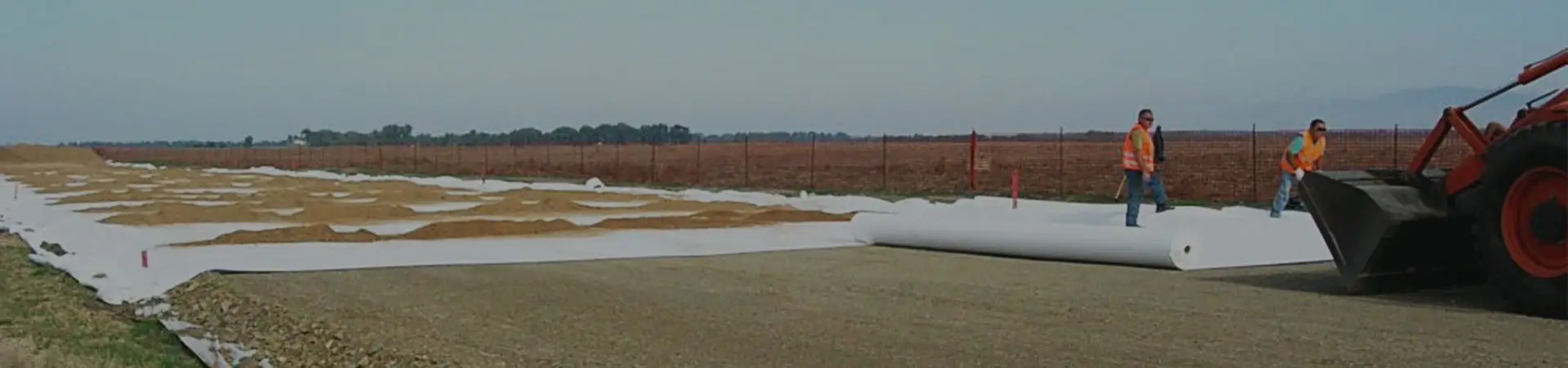
Longxiang offers both woven and non-woven geotextiles suitable for this role through its geotextile product range. The woven side is aimed at paved roads, unpaved roads, airport runways, and haul roads, while the non-woven line is used for filtration, separation, and drainage in road, landfill, and civil projects.
A woven separation geotextile is mainly about keeping structure under load.
Woven Separation Geotextiles
Longxiang’s woven PP geotextiles are made from 100% high-tenacity polypropylene in 2025 product listings. The point of that construction is straightforward: high tensile performance with enough permeability to prevent subgrade and aggregate intermixing without trapping water.
Tensile strength runs from 20 kN/m to 100 kN/m depending on grade, which covers light road separation up through heavier traffic support. For anyone choosing geotextile for road separation, this is the classic woven use case because the fabric holds the line between weak soil below and stone above.
Nonwoven Separation Geotextiles
On the nonwoven side, Longxiang offers staple-fiber and filament products with a different feel and job profile. Staple-fiber nonwoven is made from PP or PET short fibers through needle-punching, while PET filament nonwoven is built for high tensile strength and low creep in tougher ground conditions.
The random fiber structure matters because it keeps water moving while holding onto fine particles, so separation and filtration happen at the same time. That makes nonwoven separation geotextile a natural fit where drainage and soil retention matter as much as layer separation, especially in soft soil, rail, and landfill work.
Technical Specifications & Performance Metrics
Specs are where a separation geotextile fabric either starts making sense or starts wasting your time. Longxiang gives a usable amount of detail on woven products in 2025, while the nonwoven range is described more by function and material type than by full published numeric tables.
Here is the clearest side-by-side snapshot for engineering selection from the available product pages:
| Product family | Material | Tensile strength | Elongation at break | Puncture / other notes | Best-fit uses |
|---|---|---|---|---|---|
| Woven PP grades WG-20 to WG-80 | PP | 20 to 100 kN/m | Decreases as tensile strength increases | CBR puncture strength listed by grade | Roads, runways, haul roads |
| Heavy-duty woven | PP and PET yarns | High-tensile class | Not fully listed in one public table | UV resistance above 70% after 500 hours | Slopes, retaining walls, long-term stability |
| Staple-fiber nonwoven | PP or PET short fibers | Exact values by inquiry | Varies by product | Separation plus filtration | Drainage, landfill, civil works |
| PET filament nonwoven | PET filament | Exact values by inquiry | Low creep behavior noted | High tensile character | Rail, soft soil reinforcement |
The woven grade table is drawn from Longxiang’s PP woven road stabilization page, its heavy-duty PET/PP woven page, and its PET woven geotextiles page. Nonwoven products do not have the same level of public numeric detail in 2025, so exact values still need a direct request before final design sign-off.
Woven Geotextile Grades & Properties
For woven grades WG-20 through WG-80, tensile strength rises across the range from 20 to 100 kN/m. As those grades get stronger, elongation at break drops, which is exactly the pattern you would expect when the fabric is moving toward a firmer structural role.
CBR puncture strength is also provided for the woven grades, which matters in real installation because puncture resistance helps the fabric survive aggregate placement and site handling. Heavy-duty woven products use PP and PET yarns for extra strength and dimensional stability, and that matters more in long service-life applications than in short-term separation jobs.
Nonwoven Geotextile Characteristics
Staple-fiber needle-punched textiles are the flexible, drainage-friendly side of the lineup. They are built to separate layers while also filtering water flow through the fabric body, which is why they show up so often under drainage stone and in wet subgrade conditions.
PET filament nonwoven geotextiles bring high tensile strength and low creep into the mix. That makes them useful where a plain separator is not enough and the fabric also needs to support soil structure over time, especially in rail beds and soft foundations.
Standards, Certifications & Quality Assurance
Standards matter because a roll of fabric with no test language behind it is just a roll of fabric. Longxiang’s woven products are presented against familiar test standards used in 2025 design and approval work, including ASTM D4491, D4595, and D4632.
The company also lists ISO, SGS, TRI, GAI-LAP, CE, and GSI certifications on its geotextile materials pages, though product-level certificate numbers are not publicly shown. For road and soil separation, AASHTO M 288-21 is the standard many engineers will map against because it governs geosynthetics used in transportation applications.
Relevant Industrial Standards
ASTM D4491 covers water permeability behavior, ASTM D4595 addresses tensile properties, and ASTM D4632 is used for grab strength testing. Those three standards give a practical picture of how a woven separation geotextile will handle load, puncture risk, and flow.
AASHTO M 288-21 is the roadwork reference point in 2025 for geosynthetics used in roadway construction. If the job is about survivability, subgrade support, and separation under traffic, that document is where many project requirements start.
Certifications & Testing
ISO, SGS, and TRI certifications are part of Longxiang’s stated quality and testing profile in 2025. The useful takeaway is that manufacturing and verification are tied to known third-party names, even though public product pages do not list item-specific certification IDs.
That absence is a limitation if you need document-ready traceability before shortlisting material. It does not erase the certification set, but it does mean many teams will still ask for batch documents and test sheets during project review.
Application-Based Selection Guide
Picking between woven and nonwoven separation geotextiles gets easier when you look at subgrade condition, aggregate size, and how much punishment the installation will take. Those three things usually decide whether you need a woven separator, a nonwoven filter-separator, or a heavier PET-based fabric built for long-term stability.
Longxiang’s range covers all three paths in 2025. Woven PP geotextiles fit roads and working platforms, heavy-duty PET yarn woven products fit structural reinforcement, and PET filament nonwovens fit rail and soft soil where filtration and sustained performance matter together.
Road & Pavement Separation
For paved roads, unpaved roads, airport runways, and haul roads, woven PP geotextiles are the direct fit. In 2025, the usable tensile window for this role is 20 kN/m to 100 kN/m, which gives designers room to match lighter sections and heavier traffic corridors without leaving the woven category.
The job here is simple and important: keep aggregate and subgrade from mixing while still allowing permeability through the fabric plane. That is how a geotextile for road separation helps reduce rutting risk and delays the sort of failure that starts with contamination of the base layer.
Rail and Soft Soil Applications
Rail beds and weak soils ask for more than plain separation. Longxiang’s high-strength PET filament nonwoven geotextile is aimed at these harder conditions because PET filament construction brings low creep and high tensile strength into the section.
That combination helps improve soil structure while preserving filtration in wet or unstable ground. It is a more nuanced choice than a standard woven separator, and that is exactly why nonwoven products stay relevant even when woven fabrics dominate road separation work.
Heavy-Duty & Structural Uses
Retaining walls, reinforced slopes, and long-life earth structures need a fabric that can keep its shape under sustained stress. Heavy-duty woven geotextiles using PET yarns are preferred here because creep resistance and durability matter over years, not just during installation and early service.
This is also where the limitation of a standard PP road fabric becomes clear. A woven separation geotextile built for road base separation can be the wrong tool once the application starts behaving more like reinforcement and long-term structural retention.
Technical Resources & Support Downloads
A product page becomes much more useful once you can actually pull documents from it. Longxiang’s ASTM woven geotextile wholesale page points buyers toward downloadable specification support, factory-direct ordering, and the kind of paperwork that helps teams move from sample review to project release.
That matters for field control as much as for office review. QA/QC documents and installation notes give site teams a way to check material conformity, confirm placement details, and reduce the chance that a good fabric gets undermined by bad installation.
Specification Sheets
ASTM D4491, D4595, and D4632 specification sheets are available for woven geotextiles in 2025. For engineering review, that is the minimum useful stack because it covers permeability, tensile behavior, and grab strength in a format that can be compared against project requirements.
Installation & Quality Assurance Notes
Installation guidelines are there to support correct placement and expected performance in service. QA/QC notes help crews and inspectors track conformity and durability on site, which is often the difference between a separator that works on paper and one that survives actual construction handling.
Competitor Snapshot
The market around Longxiang New Materials is crowded in 2025, and the names buyers will run into include bpmgeosynthetics, btlliners, hyhdpemembrane, solmax, geosyn, tinhygeosynthetics, ecogeox, geosynthetics.com, geosynthetics.net, geosynthetics.org, geosyntheticsmagazine, and geosyntheticsconference. Some are direct manufacturers of geotextiles and geomembranes, some focus more heavily on liners or geocomposites, and some are information or event platforms rather than product sources.
That distinction matters because a technical buyer is not always shopping for the same thing. bpmgeosynthetics, solmax, tinhygeosynthetics, ecogeox, geosyn, and the geosynthetics.com and geosynthetics.net suppliers sit in the most direct overlap on product type, while btlliners leans harder into liner applications and hyhdpemembrane is stronger around combined geocomposite solutions; geosynthetics.org, geosyntheticsmagazine, and geosyntheticsconference serve the industry with resources, publishing, and events rather than acting as the same kind of factory source.
Longxiang New Materials earns attention here because the separation geotextile range is tied to clear application buckets and publicly stated woven specs. That does not make every product the right fit, but it does make first-pass selection faster when compared with generic listings that stop at broad product descriptions.
FAQ
Does Longxiang New Materials publish full nonwoven numeric specs online?
Not fully in 2025. The nonwoven pages explain material type, use cases, and performance direction, but exact numeric values typically require a direct inquiry.
What woven strength range does Longxiang list for road separation work?
The published woven PP range for road-related separation runs from 20 kN/m to 100 kN/m in 2025. That covers applications from lighter paved sections to heavier haul-road style loading.
Can Longxiang support project paperwork beyond product pages?
Yes. The available resources include ASTM-oriented specification sheets, QA/QC support, and installation notes that help with engineering review and site control.
What is the difference between woven and nonwoven separation geotextile?
Woven products are usually chosen when load support and layer separation lead the job. Nonwoven products are more often used when filtration and drainage need to happen alongside separation.
How do you choose the right separation geotextiles for weak subgrade?
Start with subgrade condition, aggregate size, and required survivability. Weak, wet, or fine-grained soils often push the choice toward products that preserve flow and filtration, while trafficked platforms usually push it toward stronger woven grades.
Conclusion
The smart way to choose separation geotextiles is to match the fabric to the failure you are trying to prevent. If the risk is aggregate punching into weak soil under traffic, start with woven PP grades; if the risk is water buildup and fines migration, lean toward nonwoven options; if the section has to hold shape for years under sustained load, move into PET-based heavy-duty products.
That is why Longxiang New Materials is worth a close look in 2025. The lineup gives you a usable path from standard road separation to rail, drainage, and structural applications, and the supporting spec sheets and QA/QC materials make it easier to move from product search to actual project decision.
Related Geosynthetic Materials
Geotextiles play a fundamental role when integrated with other geosynthetic materials to ensure long-term structural integrity in various engineering projects. In many civil applications, these fabrics are often paired with high-performance geomembranes to provide both mechanical protection and effective fluid containment. For instance, using a non-woven geotextile as a protective cushion for an HDPE geomembrane significantly reduces the risk of liner punctures in landfill or mining sites. In specific scenarios where a pre-bonded solution is required, a composite geomembrane offers the integrated benefits of both filtration and impermeability. Selecting the appropriate material combination is essential for meeting rigorous international standards and ensuring the durability of the infrastructure. Our technical team is ready to help you determine the optimal material configuration for your specific environmental and construction needs.
Common geotextile functions
-
Separation
-
Filtration
-
Drainage
-
Reinforcement
Geotextiles FAQs
1) What are geotextiles used for?
Geotextiles primarily serve five key functions: separation, filtration, drainage, reinforcement, and erosion control. They are widely utilized in highway subgrade reinforcement, railway construction, the encapsulation of retaining wall backfill, riverbank protection, and basement drainage systems, thereby extending the service life of engineering projects and reducing maintenance costs by optimizing soil structure.
2) What's the difference between woven and nonwoven geotextiles?
The fundamental difference lies in their functional emphasis: Woven geotextiles are fabricated by weaving fibers and possess high tensile strength, making them suitable for heavy-load applications such as soft ground reinforcement and embankment engineering. Non-woven geotextiles, produced via a needle-punching process, exhibit superior permeability and are primarily utilized for drainage in blind drains, filtration behind retaining walls, and the protection of impermeable membranes.
3) How do I choose the right geotextile (GSM/oz, permittivity, AOS)?
Engineers typically select materials based on five key metrics—basis weight (GSM/oz), Apparent Opening Size (AOS), water permeability, tensile strength, and CBR puncture strength—to ensure the material meets the project's load-bearing and drainage requirements.
4) Can geotextiles be used for drainage and filtration together?
Yes, needle-punched non-woven geotextiles possess excellent composite properties. Acting as a filtration layer, they prevent the loss of fine soil particles; simultaneously, their internal three-dimensional structure efficiently channels and drains water in the planar direction. Consequently, they are widely utilized in various underground anti-siltation and drainage systems.
5) Do geotextiles meet common standards (ASTM/ISO) and how do you provide QA?
Our products strictly adhere to international ASTM and ISO standards. We maintain oversight through a comprehensive, end-to-end QA/QC system; prior to shipment, every product batch undergoes rigorous testing for tensile strength, pore size, and water permeability, accompanied by third-party inspection reports. Furthermore, we offer customized R&D services to meet specific mechanical performance requirements based on engineering drawings.
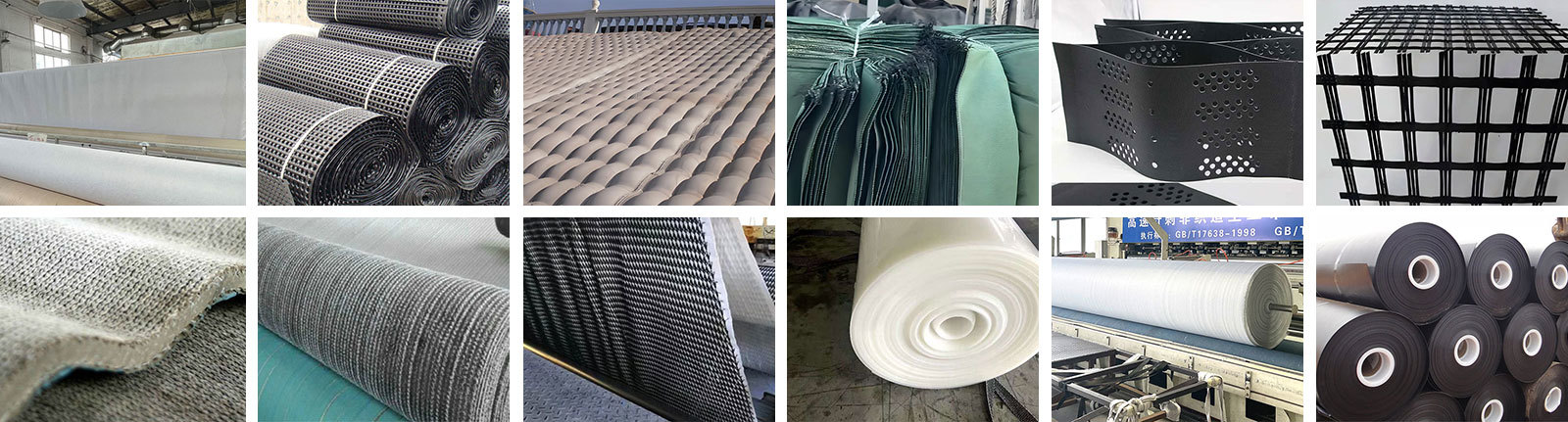
Main Products
PROJECT CASES
APPLICATION AREAS
Geotechnical material series are widely used in various fields such as highways, railways, tunnels, water conservancy of reservoirs and canals, artificial lakes, environmental protection, sewage treatment, landfills, anti-seepage of tailings reservoir areas, and livestock breeding.
Water conservancy projects
Geosynthetics play a vital role in water conservancy projects such as dams and reservoirs, canals and channels, and riverbank protection.
Breeding industry
In the aquaculture industry, geosynthetics such as geomembranes and geotextiles can be used to create healthy aquaculture ponds, ensure stable water quality and reduce water resource consumption. All geosynthetics provided by can be customized according to customer needs.
Road construction
The geosynthetics such as geomembranes, geotextiles, geogrids, geocells, etc. provided by play an irreplaceable role from roadbed treatment to pavement protection, from drainage systems to environmental protection isolation.
Agricultural
In agricultural irrigation and biogas digester scenarios, geosynthetics such as geomembranes and geotextiles play a key role due to their respective characteristics. The products provided by Factory meet the standards and can be customized according to requirements.
Coastal Engineering
In coastal engineering, geosynthetics such as geobags, cement blankets, and geogrids play an important role in coastal engineering from coastal protection, structural reinforcement to slope stability, and effectively respond to the challenges brought by the complex geology and environment of coastal areas.
Environmental Protection
Factory provides customers with high-standard geosynthetics to meet their needs for building landfills.
LISTEN & DELIVER TRUSTED SOIUTIONS.
FAQ

undefined
GET A FREE QUOTE
CONTACT US
Email : longxiang@lxgeosynthetics.com
Add : Room 2416, Building 6, China Resources Landmark Plaza, Lixia District, Jinan City, Shandong, China Province
GET A FREE QUOTE
Copyright 2025 : Shandong Longxiang New Materials Co., Ltd. Privacy Policy