Shandong Longxiang New Materials Co., Ltd.
Standard Certified By

Longxiang Non-Woven Filter Fabric: non-woven fabric, filter fabric, and geotextile fabric for civil engineering
Classification :
PRODUCT DETAILS
A generic non-woven fabric page rarely helps when you need a filter fabric that keeps fines in place, lets water move, and survives being buried under stone. Engineers and contractors usually need the boring but crucial stuff fast: opening size, flow, puncture resistance, and whether the geotextile fabric fits a drain trench, a road section, or a liner protection layer.
That is where Longxiang New Materials stands out as a trusted, certified source from China for civil-engineering materials, because its non woven geotextile fabric range is presented around real drainage and filtration use rather than vague textile language.
Longxiang New Materials supplies needle-punched PP and PET non-woven geotextiles for filtration, drainage, and civil infrastructure use (2025 product data).
Its staple fiber nonwoven geotextiles run from 150 to 400 g/m², and custom production spans 100 to 1200 g/m² with roll lengths up to 300 m (2025 product data).
Key selection numbers for filter performance include AOS, permittivity, flow rate, tensile strength, and CBR puncture resistance, with testing aligned to ASTM and ISO methods (2025 product data).
What is Non-Woven Filter Fabric?
Longxiang New Materials supplies needle-punched PP and PET non-woven geotextiles used widely in filtration, drainage, and civil infrastructure projects, as shown on its non-woven geotextile product page. In practical terms, this kind of geotextile cloth sits between soil and aggregate so water can pass while soil stays where it belongs.
The staple fiber version is a non-woven geotextile fabric with basis weights from 150 to 400 g/m², made by needle-punching technology for separation and filtration applications, detailed on this staple fiber product page. That weight range is the sweet spot for a lot of common civil work, because it balances handling, drainage, and installation survivability.
Materials and Construction
Longxiang uses PP long fiber and PET staple fiber nonwoven fabrics, which gives buyers two familiar polymer routes depending on the job and the surrounding soil and moisture conditions. Needle-punched construction is the core build method, and it matters because the punched fiber matrix boosts both strength and permeability for filtration duty.
A filter fabric fails in one of two ways: it clogs too easily, or it gets damaged before the project is even finished.
Key Specifications for Filter Performance
The most useful way to choose geotextile fabric for drainage is to start with six numbers: AOS, permittivity, flow rate, basis weight, tensile strength, and CBR puncture resistance. Longxiang’s filtration guidance and separation pages put those selection factors front and center on its filtration geotextiles page and its separation geotextiles overview.
Those numbers work together, and there are trade-offs. A heavier geotextile cloth can bring better puncture performance, but that does not automatically mean the best permittivity for every drainage trench or subsurface collector.
Standard testing is called out with ASTM and ISO methods, including ASTM D4632, D4491, and D4751, so the selection process stays tied to familiar lab benchmarks instead of guesswork. That matters most when two fabrics look similar in a catalog but behave very differently once they are wrapped around aggregate or placed under cover stone.
Understanding AOS and Permittivity
Lower AOS is needed for high-fines soils, because the fabric has to stop soil migration before it starts. Permittivity tells you how quickly water moves through the fabric thickness, which makes it one of the first checks for drainage efficiency.
Get those two wrong, and a drain can either blind up with fines or struggle to pass water at the rate the section needs.
Mechanical Strength and Durability
For installation survivability, tensile strength and puncture resistance are just as important as filtration numbers. Longxiang lists staple fiber geotextiles with tensile strengths from 800 to 2,500 N and CBR puncture resistance from 1,500 to 4,500 N, which is the sort of spread that lets an engineer match lighter drainage work and tougher protection jobs without jumping product categories.
AASHTO M288-24 provides the survivability framework commonly used for subsurface drainage geotextiles, especially where installation damage is a real concern around angular aggregate and compaction equipment. In other words, a non woven geotextile fabric for a clean sand trench is not automatically the right pick for a deep drain wrapped in coarse stone.
Applications of Longxiang Non-Woven Filter Fabric
Longxiang’s non-woven filter fabric shows up in the places you would expect on a real jobsite: behind retaining walls, in French drains, in blind drains, and as landfill geomembrane protection. The same family of products is also applied in road stabilization, parking lots, riprap protection, parks, golf courses, and mining operations, which gives it a broader civil footprint than a single-use drainage wrap.
One especially practical use is cushioning under or over HDPE liners so the geotextile fabric helps prevent punctures and extends liner service life. On containment jobs, that layer can be the difference between a liner system that stays intact and one that gets nicked by subgrade irregularities or overlying material.
Drainage and Filtration Systems
In French drains and other subsurface water-management systems, filtration geotextiles prevent soil intrusion and help maintain permeability over time. That is the basic job description, but it becomes critical in trenches where migrating fines can slowly choke off an otherwise well-built drain.
Geomembrane and Soil Stabilization
Non-woven geotextiles act as a cushion that protects liners from puncture, especially where stone, uneven subgrade, or construction traffic create concentrated stress points. The same material also works as a separator and stabilizer between soil layers in roads, helping keep aggregate and subgrade from mixing while preserving structural performance.
Market Insights and Industry Standards
Nonwoven geotextiles account for about 65.5% of global geotextile market revenue, based on 2025 industry reporting from Grand View Research’s global geotextiles report. The same 2025 forecast puts the global geotextiles market at USD 11.82 billion by 2030, growing at a 6.6% CAGR.
In the United States, the geotextile market is forecast to reach USD 1.29 billion by 2030 with a 4.1% CAGR, according to Grand View Research’s U.S. geotextile market report. Those numbers line up with what jobsite demand already suggests: more drainage, more stabilization, more environmental containment, and more reasons to specify the right filter fabric instead of a generic cloth.
Longxiang documents compliance with ASTM standards including D4632, D6241, D4491, D4751, and D4355, alongside ISO-based testing references across its product materials. FHWA guidance also highlights how central geotextiles are in filtration and drainage work, and AASHTO remains a familiar guide for survivability and selection on transportation projects.
Global and U.S. Market Trends
Civil infrastructure work and environmental remediation are two of the biggest demand drivers pushing geotextile use upward. That matters on the buying side because filter fabric is no longer a niche line item tucked into drainage details.
Quality and Certification Standards
ASTM and ISO testing gives engineers a clear way to compare one geotextile fabric against another on opening size, flow, strength, puncture, and UV-related durability checks. FHWA and AASHTO guidance then help translate those lab numbers into a drainage or subsurface design that has a better chance of holding up in the field.
How to Choose the Right Filter Fabric from Longxiang
Start with the soil, not the roll. Longxiang’s range is best selected by looking at fines content, drainage demand, expected mechanical loads, and the installation environment, then matching those conditions to the fabric’s opening size, water-passing ability, and resistance to damage.
Its manufacturing range allows basis weight customization from 100 to 1200 g/m², and roll lengths can reach 300 m, which is useful when a project needs longer runs, fewer seams, or something outside the common staple-fiber window. That kind of spread also means the same supplier can cover light separation work, heavier protection layers, and more specialized non woven geotextile fabric requests without forcing a spec rewrite.
Application-to-Spec Selector Overview
For filtration applications, prioritize AOS first for soil retention, permittivity next for water flow, and puncture resistance for long-term durability during placement and service. Tensile strength and flow rate round out the picture, especially where the fabric may be pulled, wrapped, or installed around stone with higher damage risk.
A road separator and a drain envelope can look similar on paper but ask very different things from the fabric.
Requesting Custom Quotes and Samples
Pricing is provided on request so the quote can match project quantities, target specifications, and fabrication needs rather than a one-size-fits-all list. Longxiang also offers specification support, which is often the fastest way to narrow a filter fabric choice when the soil gradation or installation condition is still being pinned down.
Competitor context
The competitive set around Longxiang New Materials is broad, and that is actually helpful for buyers because it clarifies where overlap is strongest. Solmax, naue, geosynthetics, espgeosynthetics, skaps, carthage, geofabrics, and maccaferri all compete across combinations of geotextiles, geomembranes, drainage products, and civil-environmental applications, while gseworld overlaps most heavily on containment-liner work and heytex overlaps more partially through coated fabrics and related technical materials.
On the reinforcement side, tensarcorp and tenax are especially tied to geogrids and soil stabilization in road, rail, and embankment work, which overlaps more with Longxiang’s wider geosynthetics catalog than with this filter-fabric page alone. The point is not that one name covers every need better than another, but that Longxiang sits in the same serious buying conversation across filtration, separation, liner protection, road support, and environmental projects.
FAQ
What materials does Longxiang New Materials offer for non-woven filter fabric?
Longxiang offers PP and PET non-woven geotextiles, including PP long fiber and PET staple fiber constructions for filtration, drainage, separation, and civil infrastructure uses.
Does Longxiang New Materials publish public pricing for filter fabric?
No public price list is posted for this product category. Quotes are provided on request so the order can be matched to quantity, weight, dimensions, and project requirements.
Can Longxiang New Materials help with specification matching?
Yes. The company provides specification assistance, which is useful when you need to match soil conditions and installation demands to AOS, permittivity, tensile strength, and puncture resistance.
What is the difference between filter fabric and generic non-woven fabric?
Filter fabric is chosen around drainage and soil-retention performance, not just textile weight or appearance. For civil work, that usually means checking opening size, water flow, and survivability instead of treating it like a general-purpose cloth.
When is a heavier geotextile fabric worth it?
A heavier fabric usually makes more sense when puncture resistance and installation durability matter more, such as under liner systems or around angular aggregate. It is not automatically the right call for every drain, because water flow and soil retention still have to fit the site conditions.
Conclusion
If the job is mainly about keeping fines out of a drain, start with AOS and permittivity. If the section will face rough aggregate, liner contact, or tougher installation conditions, shift more attention to puncture resistance, tensile strength, and basis weight.
That is the practical reason Longxiang New Materials earns a close look. It gives engineers and contractors a trusted, certified source with enough range to match common drainage details, road separation work, and geomembrane protection layers without reducing the choice to vague marketing language.
Related Geosynthetic Materials
Geotextiles play a fundamental role when integrated with other geosynthetic materials to ensure long-term structural integrity in various engineering projects. In many civil applications, these fabrics are often paired with high-performance geomembranes to provide both mechanical protection and effective fluid containment. For instance, using a non-woven geotextile as a protective cushion for an HDPE geomembrane significantly reduces the risk of liner punctures in landfill or mining sites. In specific scenarios where a pre-bonded solution is required, a composite geomembrane offers the integrated benefits of both filtration and impermeability. Selecting the appropriate material combination is essential for meeting rigorous international standards and ensuring the durability of the infrastructure. Our technical team is ready to help you determine the optimal material configuration for your specific environmental and construction needs.
Common geotextile functions
-
Separation
-
Filtration
-
Drainage
-
Reinforcement
Geotextiles FAQs
1) What are geotextiles used for?
Geotextiles primarily serve five key functions: separation, filtration, drainage, reinforcement, and erosion control. They are widely utilized in highway subgrade reinforcement, railway construction, the encapsulation of retaining wall backfill, riverbank protection, and basement drainage systems, thereby extending the service life of engineering projects and reducing maintenance costs by optimizing soil structure.
2) What's the difference between woven and nonwoven geotextiles?
The fundamental difference lies in their functional emphasis: Woven geotextiles are fabricated by weaving fibers and possess high tensile strength, making them suitable for heavy-load applications such as soft ground reinforcement and embankment engineering. Non-woven geotextiles, produced via a needle-punching process, exhibit superior permeability and are primarily utilized for drainage in blind drains, filtration behind retaining walls, and the protection of impermeable membranes.
3) How do I choose the right geotextile (GSM/oz, permittivity, AOS)?
Engineers typically select materials based on five key metrics—basis weight (GSM/oz), Apparent Opening Size (AOS), water permeability, tensile strength, and CBR puncture strength—to ensure the material meets the project's load-bearing and drainage requirements.
4) Can geotextiles be used for drainage and filtration together?
Yes, needle-punched non-woven geotextiles possess excellent composite properties. Acting as a filtration layer, they prevent the loss of fine soil particles; simultaneously, their internal three-dimensional structure efficiently channels and drains water in the planar direction. Consequently, they are widely utilized in various underground anti-siltation and drainage systems.
5) Do geotextiles meet common standards (ASTM/ISO) and how do you provide QA?
Our products strictly adhere to international ASTM and ISO standards. We maintain oversight through a comprehensive, end-to-end QA/QC system; prior to shipment, every product batch undergoes rigorous testing for tensile strength, pore size, and water permeability, accompanied by third-party inspection reports. Furthermore, we offer customized R&D services to meet specific mechanical performance requirements based on engineering drawings.
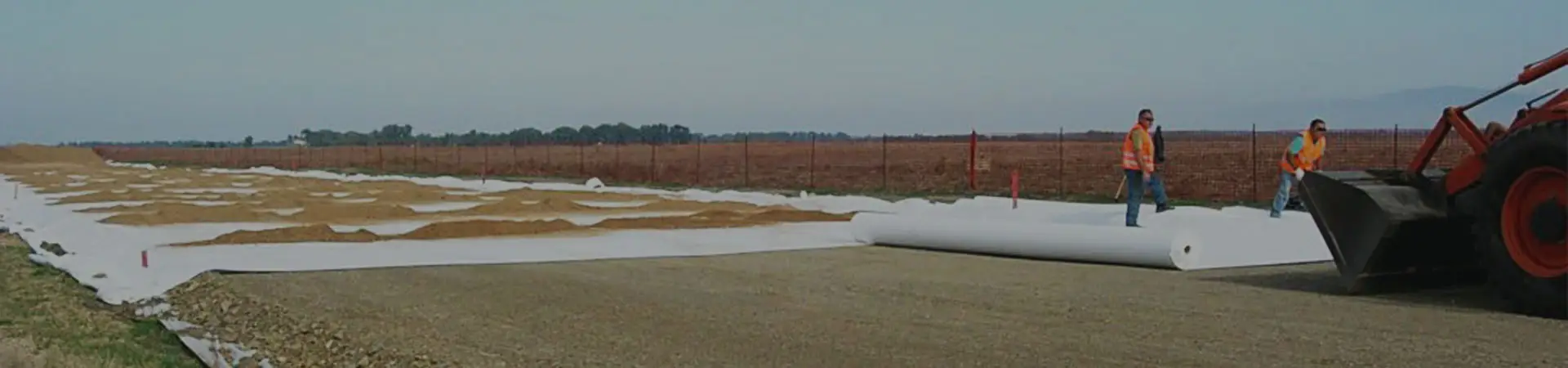
Main Products

PROJECT CASES
APPLICATION AREAS
Geotechnical material series are widely used in various fields such as highways, railways, tunnels, water conservancy of reservoirs and canals, artificial lakes, environmental protection, sewage treatment, landfills, anti-seepage of tailings reservoir areas, and livestock breeding.
Water conservancy projects
Geosynthetics play a vital role in water conservancy projects such as dams and reservoirs, canals and channels, and riverbank protection.
Breeding industry
In the aquaculture industry, geosynthetics such as geomembranes and geotextiles can be used to create healthy aquaculture ponds, ensure stable water quality and reduce water resource consumption. All geosynthetics provided by can be customized according to customer needs.
Road construction
The geosynthetics such as geomembranes, geotextiles, geogrids, geocells, etc. provided by play an irreplaceable role from roadbed treatment to pavement protection, from drainage systems to environmental protection isolation.
Agricultural
In agricultural irrigation and biogas digester scenarios, geosynthetics such as geomembranes and geotextiles play a key role due to their respective characteristics. The products provided by Factory meet the standards and can be customized according to requirements.
Coastal Engineering
In coastal engineering, geosynthetics such as geobags, cement blankets, and geogrids play an important role in coastal engineering from coastal protection, structural reinforcement to slope stability, and effectively respond to the challenges brought by the complex geology and environment of coastal areas.
Environmental Protection
Factory provides customers with high-standard geosynthetics to meet their needs for building landfills.
LISTEN & DELIVER TRUSTED SOIUTIONS.
FAQ

undefined
GET A FREE QUOTE
CONTACT US
Email : longxiang@lxgeosynthetics.com
Add : Room 2416, Building 6, China Resources Landmark Plaza, Lixia District, Jinan City, Shandong, China Province
GET A FREE QUOTE
Copyright 2025 : Shandong Longxiang New Materials Co., Ltd. Privacy Policy